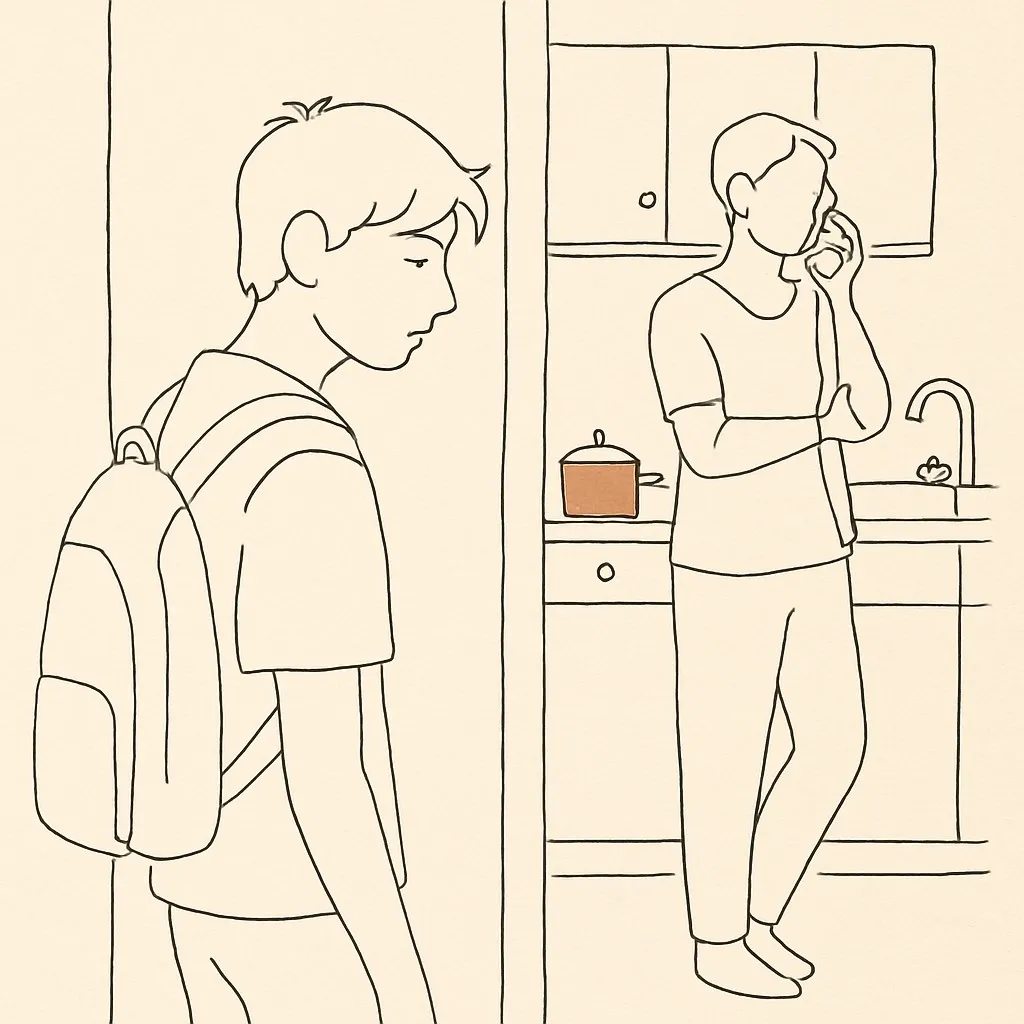
What's happening.
You're on the phone with your sister, casually mentioning your teen's recent breakup. Teen walks in, hears the last sentence, freezes, leaves the room without a word. You finish the call and walk to their door: “Hey, we should talk.” They open it just enough: “Stop telling everyone my business.”
What we usually say — and why it backfires.
Your aunt loves you. She just wants to know how you're doing.
Then SHE can ask me. You shouldn't be telling her what I told you in private.
I'm allowed to talk to my own sister about my own kid.
Then I'm not telling you anything else.
- “Your aunt loves you” explains the speaker's motive while ignoring the teen's stated harm. Motive doesn't unspeak the words.
- “I'm allowed to talk to my own sister” may be true and is conversationally fatal — it's the parent claiming a right over the teen's data.
- “I'm not telling you anything else” is the inevitable consequence and it will hold. You'll find out about the next breakup from a third party.
What works — and why.
You're right. That wasn't mine to share, especially without asking. I'm sorry. Going forward, here's the rule I'm making for myself: anything you tell me, I check with you before I share with anyone — even Aunt Karen, even Dad, even my best friend. Workable?
...workable.
And I'll call her back tomorrow and just say I shouldn't have brought it up. So she knows the door is closed unless you open it.
- “That wasn't mine to share” is the cleanest apology possible — it locates the wrongdoing in the right place (you) without minimizing.
- The “anything you tell me, I check first” rule is the policy that rebuilds trust. Teens follow rules other people set for themselves before they follow rules set for them.
- Volunteering to call Aunt Karen back is the proof-of-work that turns words into restored trust. Often the most-noticed part of the apology.
Why this script works on a teen brain.
Parent-to-extended-family information leaks are one of the most common — and most-underestimated — trust violations in adolescent parenting. Adults often don't realize they're doing it because the conversational ritual feels innocuous: how's [teen] doing, oh, you know, struggling a bit since the breakup. Five seconds, one sentence, often delivered with love. For the teen who overhears, it lands as betrayal at the exact moment they trusted you with something they didn't trust anyone else with.
Developmentally, this matters far more than parents expect. Adolescence is the period when teens are constructing the right to privacy of their own narrative — who knows what about them, in what version, with what spin. Adults extending that narrative without consent reads as identity theft. The teen response ("then I'm not telling you anything else") is logical, not dramatic.
The rebuild is specific and unusual: name a new policy you're applying to YOURSELF, not them. "Anything you tell me, I check with you before I share with anyone — even Dad, even my best friend, even Aunt Karen." The policy applied to yourself rather than imposed on them is what makes it land. Teens follow rules other people set for themselves before they follow rules set for them. Volunteering to call the leaked-to person back closes the loop with a proof-of-work the teen will notice and remember.
Same dynamic, different surface.

Your 14-year-old's grades have slipped. You vent about it to your spouse over dinner — the teen comes downstairs mid-sentence, hears you say "she's just not trying anymore," turns around, goes back upstairs. The next morning, silent breakfast. They eventually: "You think I'm not trying."
What usually happens.
I was venting to your dad. Adults are allowed to have feelings about parenting.
Yeah, but you said I'm not trying. To Dad. About me.
It was a private conversation. You weren't supposed to hear it.
So you DO think it. You just didn't want me to know.
- "Adults are allowed to have feelings about parenting" is true and the wrong response — it justifies your right to talk without addressing whether what you said was true.
- "You weren't supposed to hear it" implies the harm was in the hearing, not in the sentence. The teen is correctly pointing out that the sentence was the problem.
- "So you DO think it" is the teen catching you in the meaningful version of the truth — that the venting was your real opinion. That confirmation is more damaging than the original overhear.
What works better.
You're right that I said it and I shouldn't have framed it that way. The truth is I'm worried about you and the grades, and worry came out as 'she's not trying' when it should've come out as 'I don't know what's going on with her right now.' That's on me. I'm sorry.
...okay.
And — separately from what I should have said to Dad — can I check in with you about what IS going on with the grades? Not as a lecture. Just because I miss knowing.
...yeah. Can we walk?
- Owning the bad framing AND the underlying real feeling (worry, not contempt) is the honest repair. The teen hears: my parent has a better version of the same feeling.
- Separating the apology from the new conversation is structurally important — don't tack the lecture onto the apology, or the apology dissolves.
- "Can we walk?" from the teen is data: they're willing to keep talking, but on their terms. Walking-conversations are also developmentally optimal — side-by-side, low eye contact, freer than face-to-face.
Key phrases to reach for in the moment.
- You're right. That wasn't mine to share.
- Anything you tell me, I check with you before I share with anyone.
- I'll [undo the leak] so they know the door is closed unless you open it.
- Workable?
When to use each one.
-
You're right. That wasn't mine to share.
Use as the open. Locates the wrongdoing on you, not on their overreaction.
-
Anything you tell me, I check with you before I share with anyone — even [closest people].
Use to declare a self-imposed rule. Teens follow self-rules better than imposed-rules.
-
I'll [call them back / clarify with them] so the door is closed unless you open it.
Use to offer proof-of-work. The leak isn't repaired by promises; it's repaired by actions.
-
Workable?
Use to close the apology. Gives the teen the power to accept or refine, which is the texture of repair adolescents respond to.