I.
The scene
What's happening.
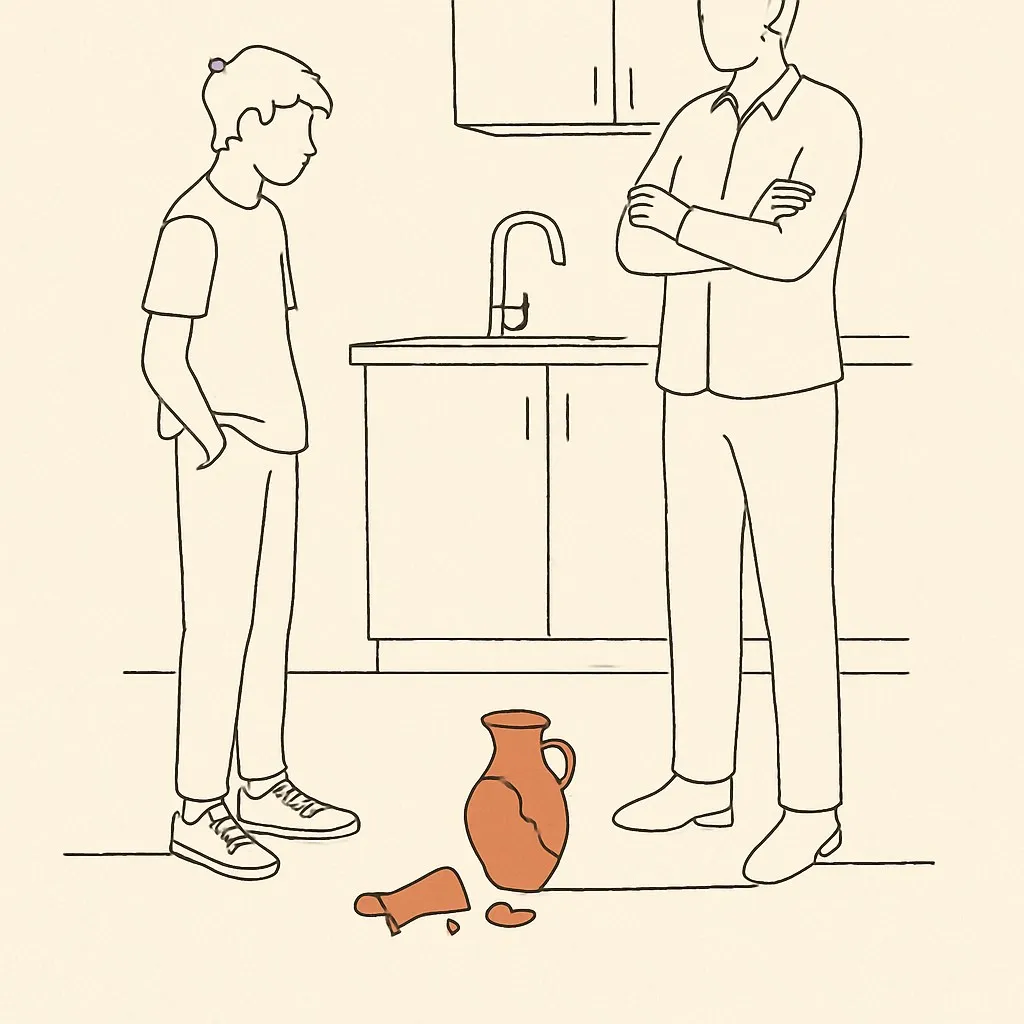
Your 15-year-old, white-faced: “Mom. I'm so sorry. I broke the vase grandma gave you.” They're already crying.
II.
The instinctive version
What we usually say — and why it backfires.
Parent
WHAT?! That was IRREPLACEABLE. How? How did you do that?
Teen
I bumped into the table. I'm sorry, I'm sorry.
Parent
I cannot believe this. I told everyone to be careful around that thing.
Teen
(internalizes: don't tell mom when you break something)
- Volume in the first five seconds turns an accident into a trauma. The teen will remember the volume far longer than the vase.
- “How did you do that?” is the question of an interrogator, not a parent. There's no good answer; it's not really being asked.
- “I told everyone to be careful” relitigates a past instruction in a moment where it doesn't help. You're not actually solving anything — you're discharging your own grief.
III.
The better version
What works — and why.
Parent
Hey. Come here. (long breath) Okay. The vase. That was an important thing and I'm sad about it. AND — you came and told me right away. That matters.
Teen
I'm so sorry.
Parent
I know. I love you a lot more than I loved the vase. Let's clean it up together. Maybe later we can talk about whether to glue any of it back as a kintsugi thing, or just say goodbye to it cleanly.
Teen
Okay. Thank you for not yelling.
- “Hey. Come here” + a long breath buys you the 5 seconds to NOT yell. Those 5 seconds are the whole game.
- Acknowledging the loss honestly (“that was important and I'm sad”) without dumping it on the teen is the model — they learn how to grieve a thing without making others responsible for the grief.
- “I love you a lot more than I loved the vase” is the sentence the teen will remember at age 40. The vase was already broken; that sentence builds the relationship.
IV.
Memorize these
Key phrases to reach for in the moment.
- Hey. Come here.
- (Long breath.)
- That was important and I'm sad about it. AND — you came and told me right away. That matters.
- I love you a lot more than I loved the [thing].