I.
The scene
What's happening.
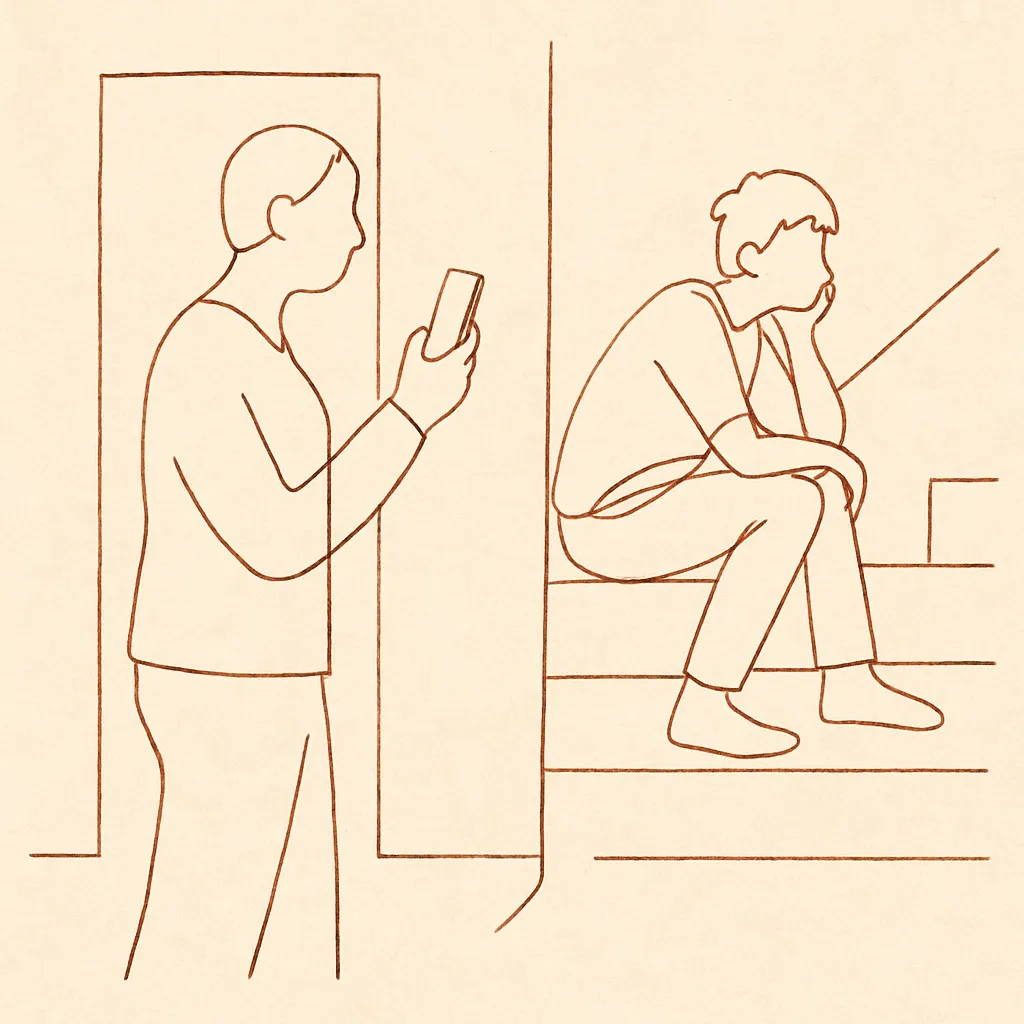
You're talking to your sister about your father's cancer diagnosis. Your 14-year-old appears in the hallway: “Why are you whispering on the phone?”
II.
The instinctive version
What we usually say — and why it backfires.
Parent
Nothing. Just sister stuff.
Teen
It didn't sound like nothing.
Parent
It's adult stuff, it's fine, go to your room.
Teen
(learns that there are family things you actively lie about. Doesn't trust the answer next time something seems wrong.)
- Calling a hard family conversation “nothing” is a lie the teen detects. They'll catalog it.
- “Adult stuff, go to your room” treats the teen as a non-member of the family, which they're not.
- The bigger cost is downstream: the teen won't ask about the next worrying thing because asking didn't get them the truth this time.
III.
The better version
What works — and why.
Parent
Honest answer — there's something I'm not ready to talk to you about tonight. I will, soon, just not in this hallway, not while I'm on the phone with Aunt Karen. I'm not okay-not-okay; nobody is in immediate danger. But it's not nothing, you're right.
Teen
...okay. Like, this weekend?
Parent
This weekend. I promise. Thank you for asking. The honest answer is one I owe you.
- “There's something I'm not ready to talk about tonight” is the honest non-lie — it admits there's something without dumping it.
- “I'm not okay-not-okay; nobody is in immediate danger” gives the teen the minimum information their brain needs to not catastrophize while sleeping on it.
- Naming a real timeline (“this weekend”) and keeping it is the proof that pays back trust.
IV.
Memorize these
Key phrases to reach for in the moment.
- Honest answer — there's something I'm not ready to talk about tonight. I will, soon.
- I'm not okay-not-okay; nobody is in immediate danger. But it's not nothing.
- [A real timeline.]
- The honest answer is one I owe you.