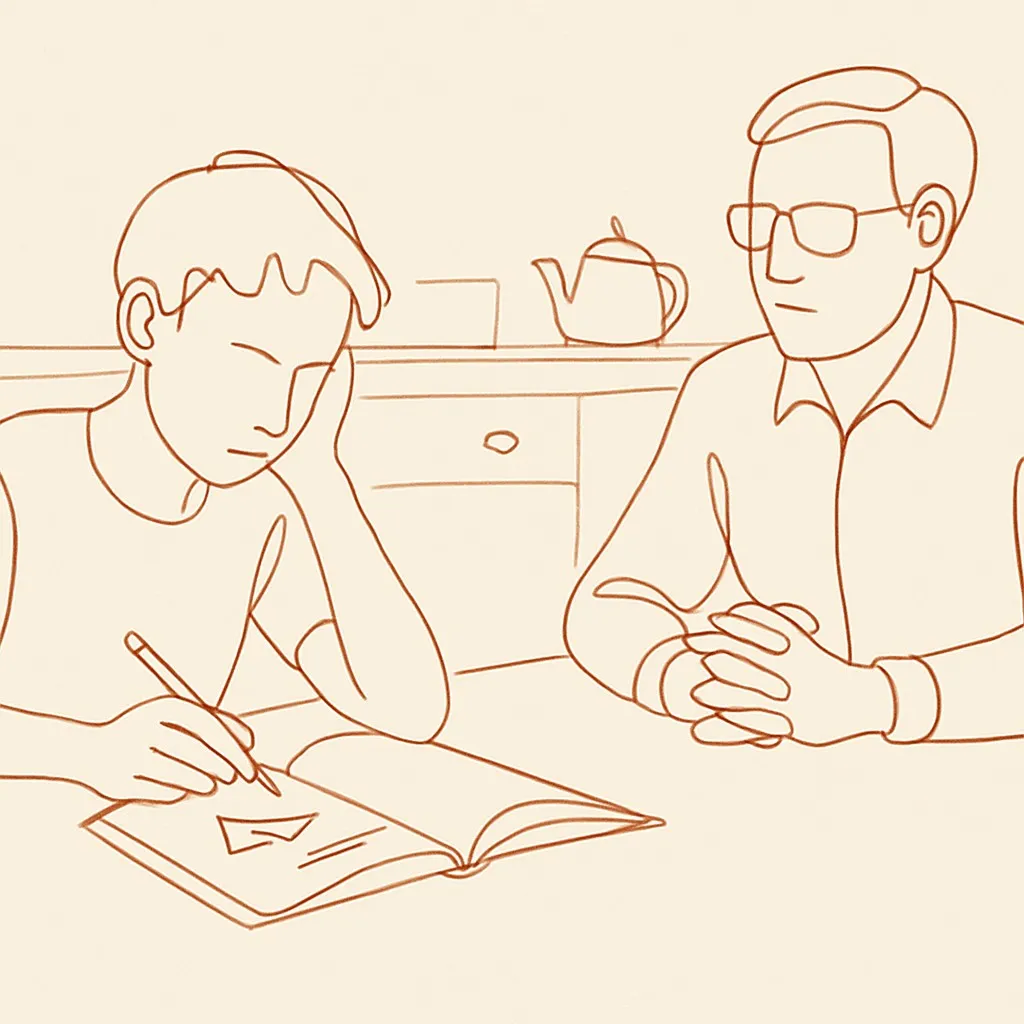
What's happening.
Your 14-year-old, head down, almost a mumble: “I'm failing math.” The progress report is in your hand and you already knew.
What we usually say — and why it backfires.
I SAW. I've been waiting for you to bring this up. Why didn't you tell me sooner?
Because I knew you'd be mad.
I'm mad you didn't tell me, not about the grade. Well, both.
(stops bringing you any school news pre-emptively)
- “I've been waiting for you to bring this up” is parent-as-trap, which the teen will note and avoid forever after.
- “Mad you didn't tell me” punishes the very thing you most want them to do — bring you bad news early.
- The “(both)” lights up both shame channels in the teen brain. The next failing grade will arrive without warning.
What works — and why.
Okay. Thank you for telling me. That took guts. Walk me through what's going on — what's the unit, what's clicking, what isn't.
It's quadratics. I missed the foundation and now everything builds on it.
Okay, that's a fixable problem. Three options: I can sit with you, you can do Khan Academy on the missed unit, or we can get a few sessions with a tutor — your teacher probably knows a high schooler who does it cheap. Which sounds most like you'll actually use it?
Probably the tutor. Like an actual person but not you.
Done. I'll ask Mr. K tomorrow. Heads up to you — when grades start to slip again, tell me early. Telling me early is never the wrong move.
- “Thank you for telling me. That took guts” turns the confession into a reward for the behavior you want. They'll do it again next time.
- Asking for unit / clicks / doesn't-click treats failing math as a diagnosable problem rather than a character verdict — and gets you the actual answer.
- “Telling me early is never the wrong move” codifies the principle in language they'll remember the next time they sit on bad news.
Key phrases to reach for in the moment.
- Thank you for telling me. That took guts.
- Walk me through what's going on — what's the unit, what's clicking, what isn't.
- That's a fixable problem. (Then offer specific options.)
- Telling me early is never the wrong move.