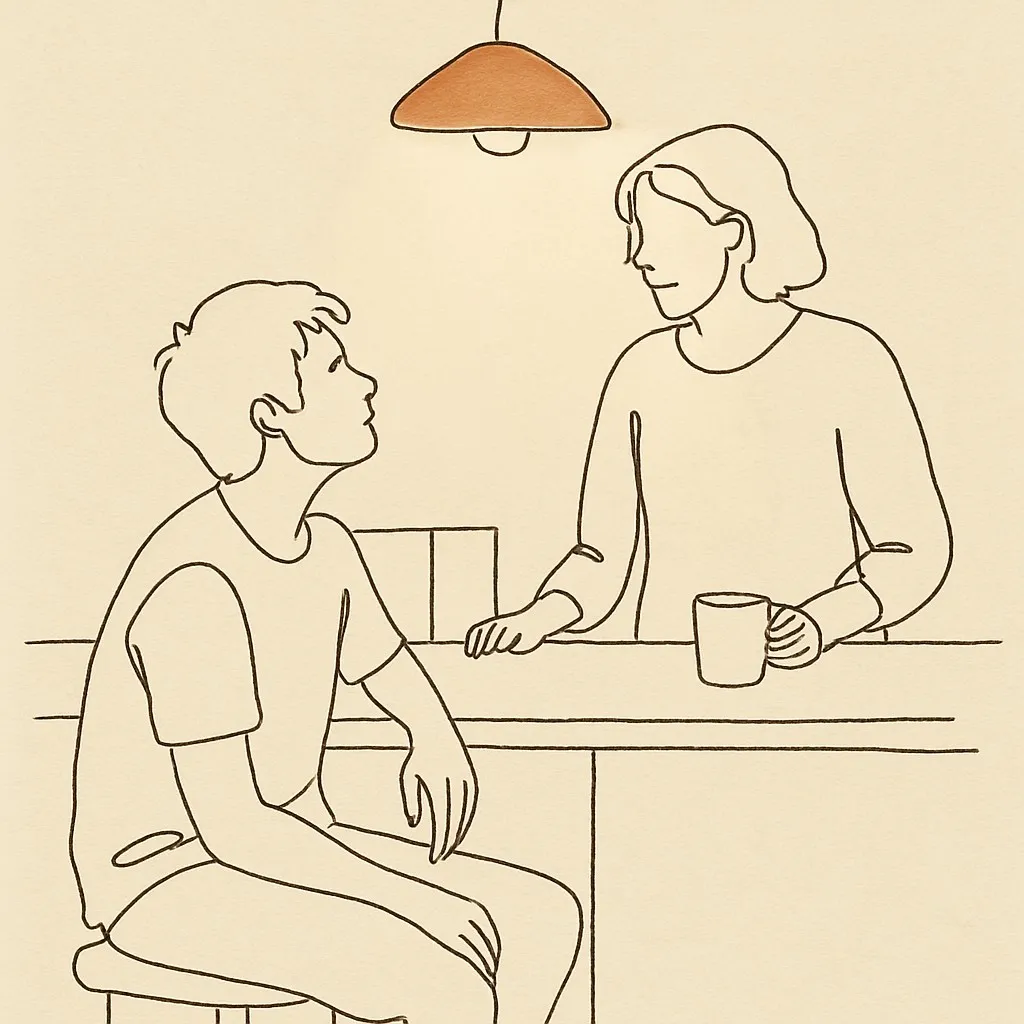
What's happening.
Your 15-year-old wants to spend the night at a friend's house. You say no. They look hurt: “Why don't you trust me?” It's a fair question. The answer is more nuanced than yes or no.
What we usually say — and why it backfires.
I do trust you. I just don't want you to.
That doesn't make sense. If you trusted me you'd let me.
Trust isn't the issue. I said no.
(walks away convinced you don't trust them, regardless of what you said)
- “I do trust you, I just don't want you to” is a contradiction the teen will press until you cave or hurt them more.
- “Trust isn't the issue. I said no” asserts authority without the why, which the teen experiences as the parent being unwilling to be honest.
- Either way, you've made the trust question central without answering it. The “no” will hold for the night but cost trust for weeks.
What works — and why.
Honest answer? Mostly yes. I trust you to make good choices. Where I'm less sure is when other people's choices are around you and the situation gets ahead of you. That's the trust gap I'm working on.
What do you mean?
You're good in the moment. Where I worry is when someone shows up with something you didn't expect and you have to think on your feet at 1am. So for sleepovers right now — yes if I know the family, slower if I don't. Not a forever rule. A working rule.
Okay. I'd rather have that than just 'no.'
- “Mostly yes” is closer to true than the binary “I trust you” / “I don't.” Teens respect nuance more than they respect false certainty.
- Naming the specific trust gap (you, vs. you-when-other-people-are-around) tells them what behavior would actually move the line. That's actionable.
- “Not a forever rule. A working rule” puts a timeline on the restriction, which makes it tolerable instead of identity-threatening.
Why this script works on a teen brain.
Trust in adolescence is not a binary the teen can earn back; it's a developmental gradient the parent maintains while the teen's autonomy widens. The mistake parents make most often is treating "I trust you" as an atomic claim — either I do or I don't — when the honest answer is almost always more like a 70-90% blend of trust calibrated to specific situations.
Nuance reads to a teen as honesty. The binary reads as a lie. "I trust you in your room with the door closed, I'm less sure when you're at a party where I don't know anyone" is not a hedge — it's the truth, said in a form the teen can engage with. The conversation that follows is the one where they actually negotiate themselves into more freedom, instead of resenting blanket restrictions.
The sentence "not a forever rule, a working rule" is the secret one. Teens accept restrictions with end conditions and resent restrictions without them. Naming a restriction as time-bound or behavior-bound makes it a system to work with, not an identity claim to fight.
Same dynamic, different surface.
Your 17-year-old wants to take a road trip with two friends for spring break — three days, three states. They tell you the plan. You say "let me think about it." They later: "You don't trust me, that's why you can't just say yes."
What usually happens.
It's not about trust. I'm a parent. That's a big trip.
Right, so you don't trust me.
Drop the trust thing. I said I'd think about it.
Just say no then.
- "It's not about trust" denies what the teen is naming AND closes the door on the actual question.
- "Drop the trust thing" is the parent refusing to engage with the developmental frame the teen brought.
- "Just say no then" is the teen daring you to make it simpler than it is — they're correct that the lack of a real answer is the problem.
What works better.
You're right that trust is in it. Real answer: I trust your judgment day-to-day. What I'm less sure about is the unknowns of three days on the road — flat tire at midnight, motel sketchier than advertised, somebody offers you something. Let me come back tomorrow with the actual yes-and-conditions answer.
Okay.
(Next morning.)
Yes. Conditions: shared location, check-in text morning and night, AAA membership active, $200 emergency cash, and we talk through the route once together. None of those are because I don't trust you. All of those are because I love you and roads at 2am are weird.
Deal. That's actually fair.
- Conceding that trust IS in it ("you're right") meets the teen at their frame instead of fighting over the label.
- Asking for 24 hours then coming back with a real plan is the opposite of "let me think about it" feeling like a stall — it feels like the conversation actually moves.
- Framing every condition as "because I love you" not "because I don't trust you" gives the teen the right reason for each rule. They'll follow rules whose motive they accept.
Key phrases to reach for in the moment.
- Honest answer? Mostly yes.
- Where I'm less sure is [specific context].
- Not a forever rule. A working rule.
- Here's what would move the line.
When to use each one.
-
Honest answer? Mostly yes.
Use as the first response to "why don't you trust me?" — nuance reads as honest, binary reads as a lie.
-
Where I'm less sure is [specific context].
Use to name the actual gap. Specific contexts are negotiable; vague "I don't know" turns into a fight.
-
Not a forever rule. A working rule.
Use to put a timeline on the restriction. Teens accept time-bound rules; they rebel against identity-claim rules.
-
Because I love you, not because I don't trust you.
Use to label every condition with its actual motive. Sticks much better than a list of rules without context.