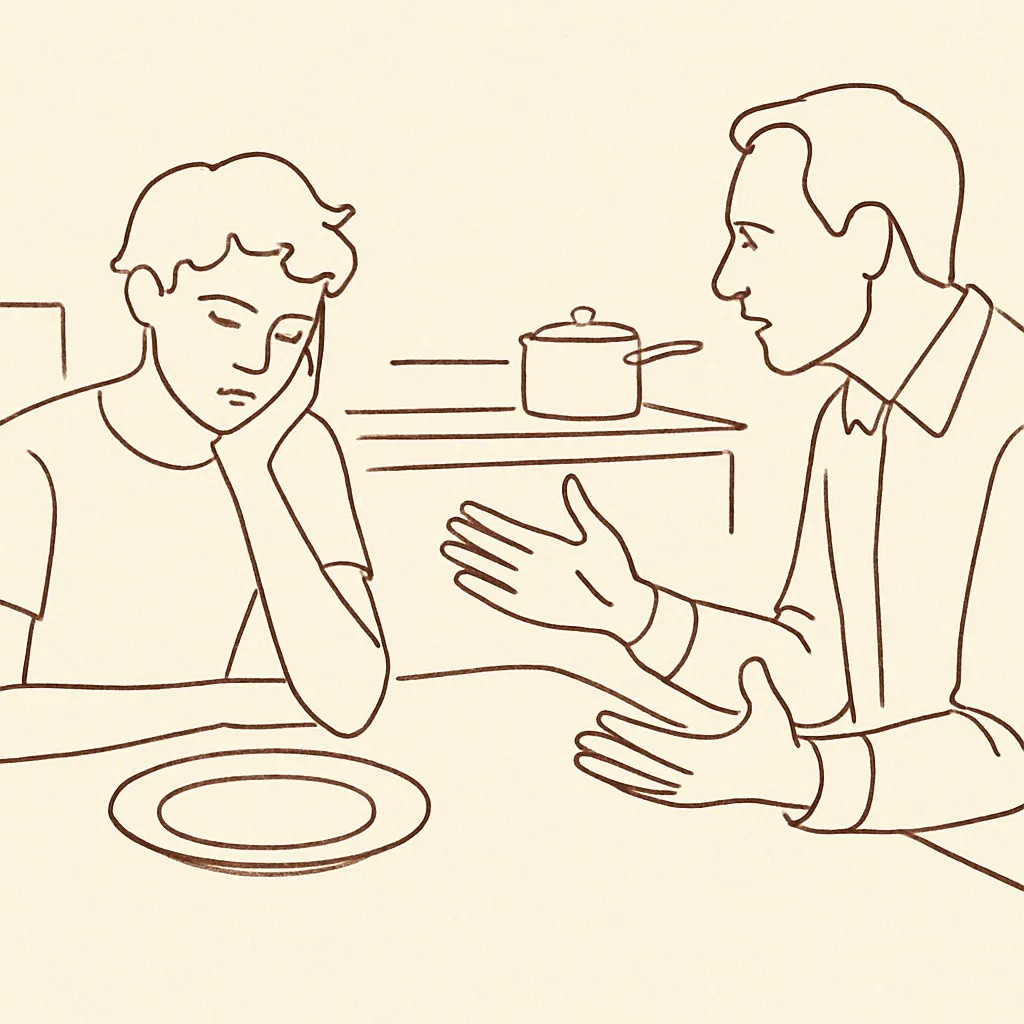
What's happening.
Your 14-year-old, head down, voice small: “I think I might have an eating disorder. I haven't really eaten in three days. I don't want to.”
What we usually say — and why it backfires.
Oh sweetheart, no — you're fine, you just need to eat something. Let's get you a sandwich.
I can't. I literally can't.
Of course you can. Just try.
(stops telling you anything for months while it gets worse)
- “You're fine” is the parent declaring something the teen just said they weren't. They'll defer to your declaration outwardly and the disorder runs underneath.
- Solving it with a sandwich in the next ten minutes treats an eating disorder like hunger. They're medically different things.
- The teen learns: bringing this up to mom = denial. The next disclosure is to an ER triage nurse.
What works — and why.
(sits down) Okay. Thank you for telling me. That took huge courage. I want to make sure I understand — three days without much, and you don't want to. Is that the whole picture, or is there more?
I've been throwing up after eating sometimes too. For a few months.
Okay. That's important medical information and I'm so glad you told me. This is real and treatable. Tomorrow morning I'm calling your pediatrician and asking for an emergency referral to an eating-disorder specialist — not a regular therapist, the specialized kind. You're not in trouble, you're not broken. People recover from this all the time with the right help. Tonight — can you eat one small thing with me, not because it'll fix anything, just so your body has something? I'll sit with you while you do.
...okay. Just toast maybe.
- “Thank you for telling me. That took huge courage” is the response that earns you the FULL picture (the months-long vomiting bit they wouldn't have led with).
- “Emergency referral to an eating-disorder specialist — not a regular therapist” is the medically right move. Eating disorders have one of the highest mortality rates in psychiatry; specialist care matters.
- “Eat one small thing with me, I'll sit with you” is the right tonight-move — small, witnessed, non-shaming. Not a full meal, not a confrontation.
Key phrases to reach for in the moment.
- (Sit down.) Thank you for telling me. That took huge courage.
- Is that the whole picture, or is there more?
- This is real and treatable. People recover from this all the time with the right help.
- Can you eat one small thing with me, just so your body has something? I'll sit with you.
Eating disorders are a medical emergency, not a behavioral issue. NEDA Helpline 1-800-931-2237, NEDA Crisis Text Line: text NEDA to 741741. Pediatrician this week, referral to an adolescent-eating-disorder specialist or program — most major children's hospitals have a dedicated team. If actively purging, severely restricting, or fainting: ER. Eating disorders have one of the highest mortality rates of any psychiatric condition; early treatment massively improves prognosis.