The short version.
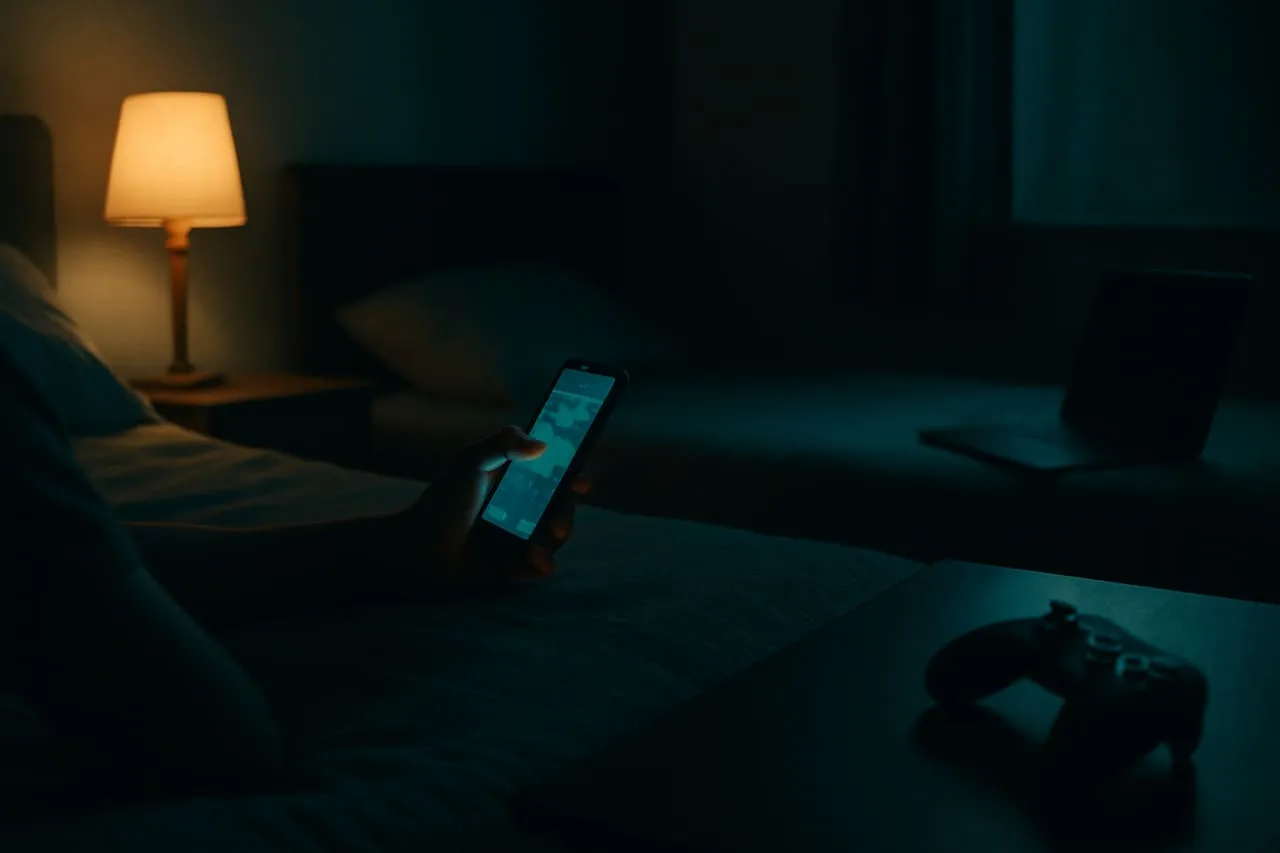
Summer break removes the three biggest structural limits on teen screen time — the school day, the bedtime, and the homework block — without replacing them. Within a week or two, most U.S. teens drift from a school-year baseline of about 4 hours of recreational screen time per day to 7-9 hours, according to Common Sense Media's recurring tracking surveys. The drift is gradual, parent-invisible, and remarkably difficult to walk back in August.
The platforms and contexts.
Every U.S. household with a teenager from roughly mid-June to late August. More pronounced in single-parent and dual-working households where no adult is home during weekdays; less pronounced in households with daily summer programming (camp, jobs, sports practice).
The timeline.
The pattern has been documented every summer since smartphone saturation reached teens (around 2013). Common Sense Media's 2021 and 2024 surveys both put summer screen time roughly 50-90% higher than school-year baseline.
The core facts a parent needs.
- The drift is not a willpower problem on the teen's part. With no structural day, screen time is the path of least resistance — boredom is uncomfortable, alternatives require initiation.
- The fall return to school is where this becomes visible: teens who drifted to 8-9 hours/day in July fight harder against the school-year limit and sleep less in September.
- Sleep is the biggest casualty. Without a 7am wake-up, bedtime quietly slips to 1-2am, and the teen's circadian phase shifts further — making the back-to-school transition genuinely brutal.
What's actually at stake.
- Sleep-schedule collapse that takes weeks to repair when school resumes.
- Worsening mood, irritability, and 'summer depression' that parents often attribute to hormones or the teen being 'difficult' — and which often improves immediately when structure returns.
- Specific high-risk patterns intensify in unstructured time: pro-ana/pro-mia content, AI chatbot dependence, gambling and skin trading, sextortion (which spikes summer), and substance experimentation that happens because no one is home.
The talk that lands — try it now.
Imagine you just learned your teen brushed up against this. You have 60 seconds before the conversation begins. What you say first decides whether the next 20 minutes opens the door — or slams it.
"What were you thinking? Give me your phone — now."
Panic + punishment in the same breath. The teen reads it as "every honest detail will be used against me." The phone comes; the truth doesn't.
What would you open with instead? Picture it for a beat — then…
"I want to ask about something — no trouble, I just want to understand it. Can we sit for five minutes?"
Curiosity, not court. Promise of safety in the first sentence. Time-bounded so it doesn't feel like a trap. Almost every teen says yes to five minutes.
Then, in those 5 minutes:
- Build a 'summer scaffold' in week one, not week six: one anchor activity per weekday morning (a job, a camp, a sport practice, a class, a volunteer slot, a weekly grandparent visit), one social commitment per week, one daily outdoor block.
- Keep the school-year sleep rule by default — phone out of the room at 10pm, lights out by midnight. Defending one boundary is far easier than defending three.
- Have the summer screen conversation in May, not June. 'When school ends I want us to agree on a daily ceiling and a daily floor of non-screen.' Numbers attached: e.g. 4-hour daily ceiling, 1-hour daily outside.
Try saying it out loud once before you close this tab. Cool parents rehearse — yelled parents wing it.
Practice 200 more parent–teen scripts →Concrete next steps.
- Build a 'summer scaffold' in week one, not week six: one anchor activity per weekday morning (a job, a camp, a sport practice, a class, a volunteer slot, a weekly grandparent visit), one social commitment per week, one daily outdoor block.
- Keep the school-year sleep rule by default — phone out of the room at 10pm, lights out by midnight. Defending one boundary is far easier than defending three.
- Have the summer screen conversation in May, not June. 'When school ends I want us to agree on a daily ceiling and a daily floor of non-screen.' Numbers attached: e.g. 4-hour daily ceiling, 1-hour daily outside.
Call or text 988 (Suicide & Crisis Lifeline, 24/7) · Text HOME to 741741 (Crisis Text Line) · Find a child psychiatrist at aacap.org · For immediate danger, call 911.