The short version.
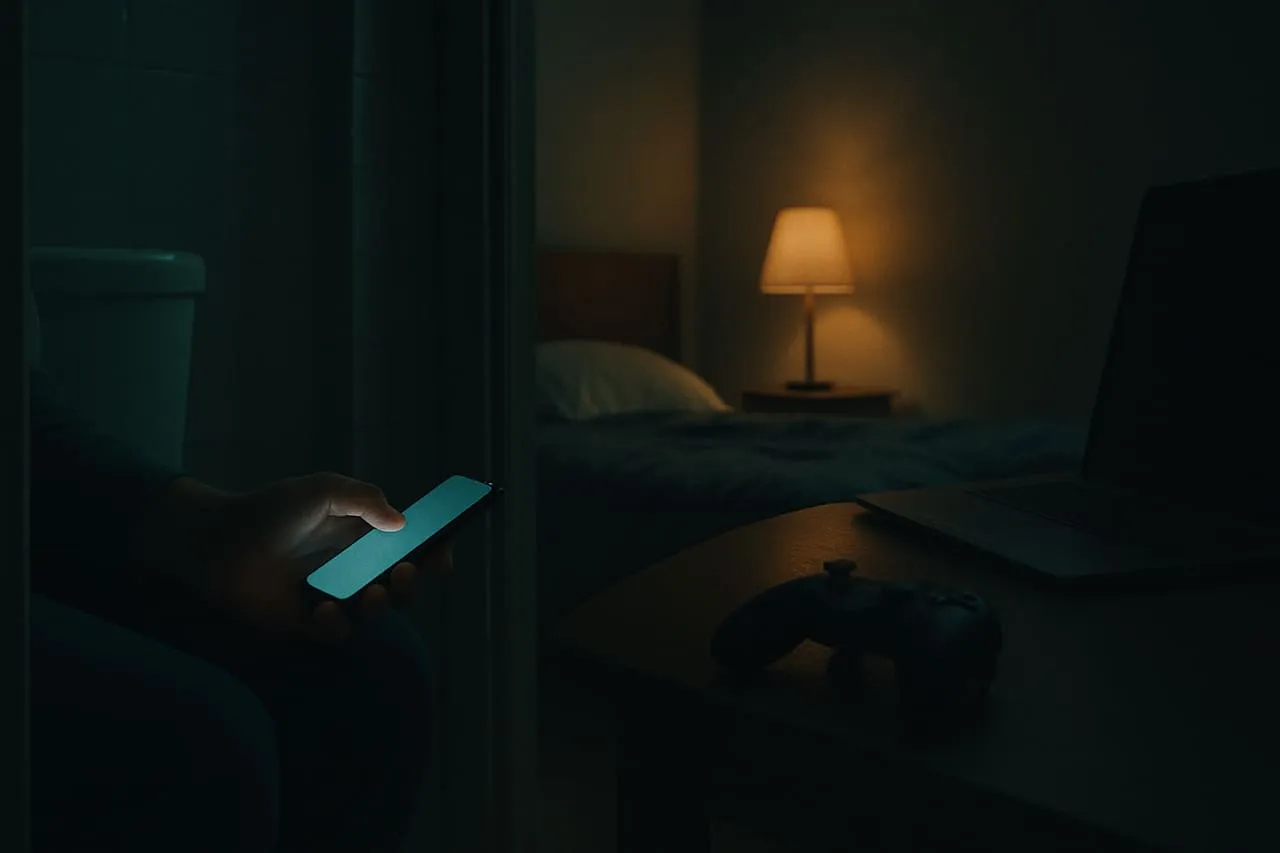
A teen retreating into the bathroom with their phone for long stretches — sometimes an hour or more, multiple times a day — is one of the most universal screen-creep patterns parents describe. The bathroom is the room with a culturally sanctioned lock; no one will knock unless they actually need it. It becomes the room where the most absorbing, private, or distressing content gets consumed: doomscrolling, comparison videos, DMs from a complicated person, porn, AI chatbots, or just the loop the algorithm has built for that teen.
The platforms and contexts.
Every household with a teenager. More common in households with a phone basket / no-phones-in-bedroom rule — the phone-in-the-bathroom session is often the workaround. Also common right before bed and immediately after school.
The timeline.
A reliable pattern since smartphones became universal among teens (around 2012). The bathroom-as-screen-room pattern is documented by sleep researchers, family therapists, and pediatricians.
The core facts a parent needs.
- It is almost never about defying you. It is about the brain needing a private space to do something — escape, decompress, scroll, talk to someone — that feels too exposed in shared space.
- Long bathroom sessions correlate with screen distress more than screen pleasure — the content that drives this pattern is more often comparison content, DMs with a difficult person, or porn than it is gaming or watching a show.
- The pattern can mask something specific: an eating disorder behavior, a difficult online relationship, sextortion, self-harm content, or simply an algorithm that's been serving distressing content the teen can't tell you about.
What's actually at stake.
- Sleep loss — the late-night bathroom session is a frequent route around 'phones charge in the kitchen' rules.
- The privacy lets distressing content escalate unobserved: pro-ana content, self-harm imagery, sextortion negotiation, AI chatbot dependence, porn use that's spiraling.
- Physical signs of long sessions on the toilet (numbness, hemorrhoids in teens) is now common enough that pediatricians ask about it routinely.
The talk that lands — try it now.
Imagine you just learned your teen brushed up against this. You have 60 seconds before the conversation begins. What you say first decides whether the next 20 minutes opens the door — or slams it.
"What were you thinking? Give me your phone — now."
Panic + punishment in the same breath. The teen reads it as "every honest detail will be used against me." The phone comes; the truth doesn't.
What would you open with instead? Picture it for a beat — then…
"I want to ask about something — no trouble, I just want to understand it. Can we sit for five minutes?"
Curiosity, not court. Promise of safety in the first sentence. Time-bounded so it doesn't feel like a trap. Almost every teen says yes to five minutes.
Then, in those 5 minutes:
- Don't bust down the door. The behavior is almost always a coping move; busting in confirms that you are a threat to their safe-space and they will find a new one (under the covers, in the car, in the basement).
- Name it once, gently, in a calm moment: 'I noticed the long bathroom sessions. I'm not asking what you're doing — but I want you to know I see it, and I'm here if any of it is heavy.'
- Make a no-phones-in-the-bathroom-after-9pm household rule — for adults too. Phone lives in the charging spot from 9pm onward. The rule that applies to everyone is the rule that holds.
Try saying it out loud once before you close this tab. Cool parents rehearse — yelled parents wing it.
Practice 200 more parent–teen scripts →Concrete next steps.
- Don't bust down the door. The behavior is almost always a coping move; busting in confirms that you are a threat to their safe-space and they will find a new one (under the covers, in the car, in the basement).
- Name it once, gently, in a calm moment: 'I noticed the long bathroom sessions. I'm not asking what you're doing — but I want you to know I see it, and I'm here if any of it is heavy.'
- Make a no-phones-in-the-bathroom-after-9pm household rule — for adults too. Phone lives in the charging spot from 9pm onward. The rule that applies to everyone is the rule that holds.
Call or text 988 (Suicide & Crisis Lifeline, 24/7) · Text HOME to 741741 (Crisis Text Line) · Find a child psychiatrist at aacap.org · For immediate danger, call 911.