The short version.
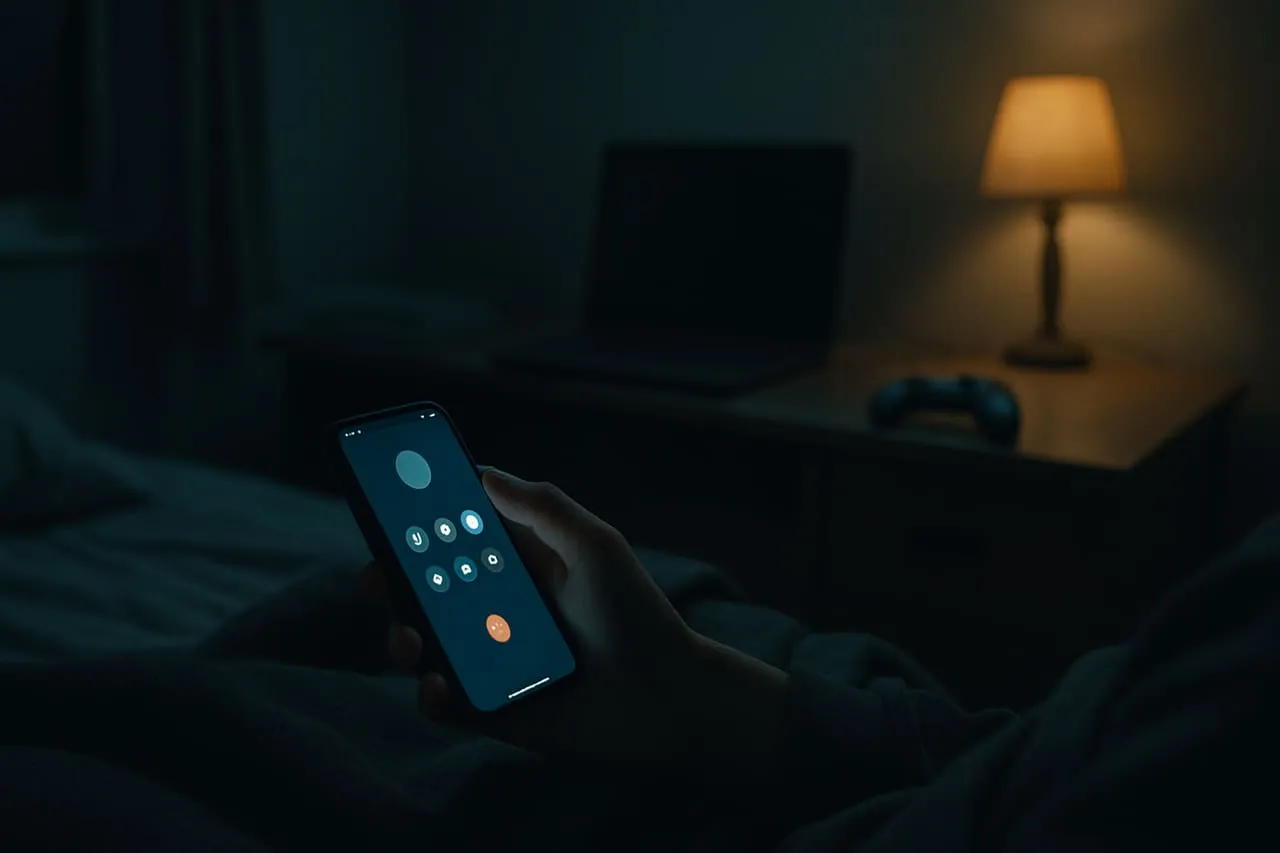
The 'voice-chat sleepover' is the new sleepover. A group of friends (or in many cases, friends + a friend-of-a-friend nobody actually knows) join a Discord or in-game voice channel after dinner and stay there past midnight, often all the way to dawn. They are talking, gaming, half-watching YouTube together, and falling asleep in headsets. The behavior is technically pro-social — they're connecting with friends — and the cost falls almost entirely on sleep and on attention the next day.
The platforms and contexts.
Discord voice channels, Roblox party voice (for verified 13+), Fortnite party chat, Minecraft realm voice, PlayStation Party, Xbox Party. The platform-hopping pattern is normal — kids will move between voice systems through one session.
The timeline.
Has been a documented pattern since Discord went mainstream around 2018; intensified during the 2020 pandemic when voice-chat became the only sleepover; never went back to baseline. Sleep researchers consistently flag it as a major new contributor to teen sleep deprivation.
The core facts a parent needs.
- Even when every kid in the voice chat is known to you, the sleep loss alone is significant. CDC recommends 8-10 hours for teens; voice-chat-sleepover nights typically deliver 4-6.
- Most groups will eventually include someone nobody has met — a friend's cousin, an online friend, someone from a Roblox lobby. The 'stranger danger' risk re-enters at that point.
- Many parents think the kid is asleep at 11pm because the room is dark and quiet — the headset and dim screen are invisible from the hallway. A simple door-cracking check at midnight tells the truth.
What's actually at stake.
- Chronic sleep deprivation, which directly impacts mood, grades, athletic performance, immune function, and growth.
- Predator exposure when an unknown kid joins; voice grooming and off-platform handoffs are most common in these long, late, low-supervision sessions.
- Cumulative exposure to language, content, and social dynamics most parents would intervene on if they were sitting in the room — racial slurs, sexual jokes, gambling talk, drug talk — that pass unfiltered in voice.
The talk that lands — try it now.
Imagine you just learned your teen brushed up against this. You have 60 seconds before the conversation begins. What you say first decides whether the next 20 minutes opens the door — or slams it.
"What were you thinking? Give me your phone — now."
Panic + punishment in the same breath. The teen reads it as "every honest detail will be used against me." The phone comes; the truth doesn't.
What would you open with instead? Picture it for a beat — then…
"I want to ask about something — no trouble, I just want to understand it. Can we sit for five minutes?"
Curiosity, not court. Promise of safety in the first sentence. Time-bounded so it doesn't feel like a trap. Almost every teen says yes to five minutes.
Then, in those 5 minutes:
- Set a hard end-time on voice chat just like you would on a real sleepover. 'Headset out of the room at 10pm' is a reasonable middle-school rule; 11pm for high-schoolers.
- Keep the gaming setup in shared space if possible. The voice-chat-sleepover is a bedroom phenomenon precisely because the bedroom door closes.
- If you must keep it in the bedroom, hardwire the router to power-down the kid's devices at a set time. Most consumer routers have this in the parental controls menu; it ends the negotiation.
Try saying it out loud once before you close this tab. Cool parents rehearse — yelled parents wing it.
Practice 200 more parent–teen scripts →Concrete next steps.
- Set a hard end-time on voice chat just like you would on a real sleepover. 'Headset out of the room at 10pm' is a reasonable middle-school rule; 11pm for high-schoolers.
- Keep the gaming setup in shared space if possible. The voice-chat-sleepover is a bedroom phenomenon precisely because the bedroom door closes.
- If you must keep it in the bedroom, hardwire the router to power-down the kid's devices at a set time. Most consumer routers have this in the parental controls menu; it ends the negotiation.
Call or text 988 (Suicide & Crisis Lifeline, 24/7) · Text HOME to 741741 (Crisis Text Line) · Find a child psychiatrist at aacap.org · For immediate danger, call 911.