Phone-locking pouches and bell-to-bell policies remove the willpower problem — teachers stop policing, kids talk to each other again, and the social climate improves within weeks.
The situation, the move, the outcome.
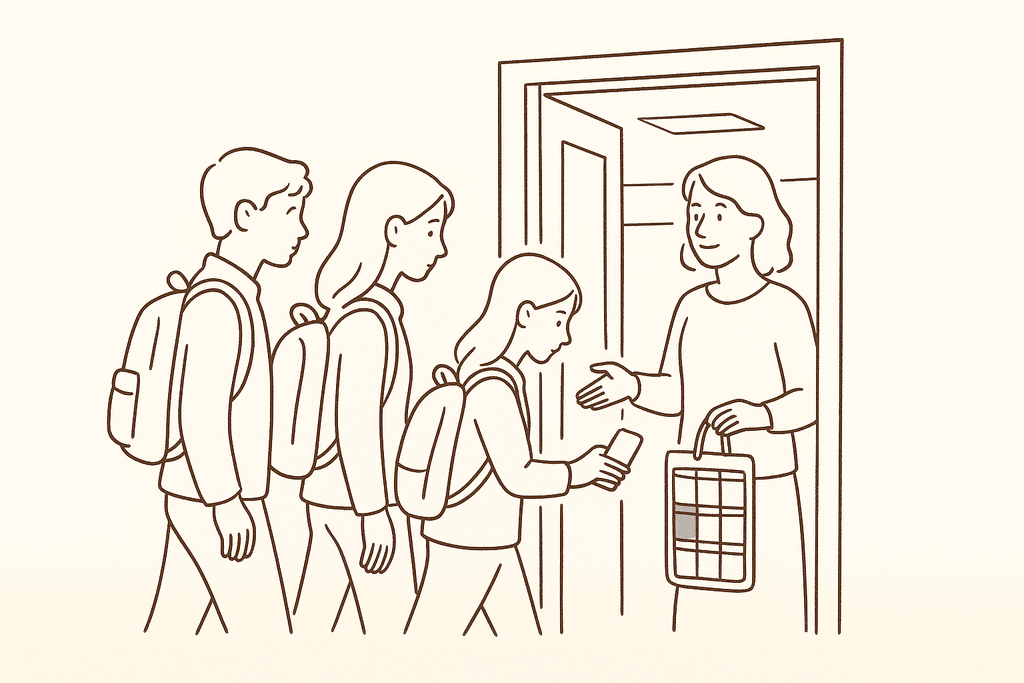
Yondr makes a magnetically locking pouch — the student keeps possession of their phone, but it's locked inside the pouch from first bell to last and can only be unlocked at a base station at the end of the day. Schools that adopted it (San Mateo High in California, Buxton School in Massachusetts, hundreds more by 2024) report that within a few weeks teachers stopped policing phones, hallway conversations restarted, and kids who'd been buried in screens at lunch were talking again. By 2024-2025 the policy went mainstream: federal guidance from the U.S. Surgeon General and HHS, statewide bell-to-bell phone-free laws in Florida, Indiana, Louisiana, South Carolina, Virginia, California, New York and others, and large districts (Los Angeles Unified, NYC) following. Independent reviews — RAND and Cyberbullying Research Center — found principals reporting better climate, reduced in-school cyberbullying, and stronger student engagement under bell-to-bell policies.
Why it matters beyond one family.
The honest picture on phone-free school evidence: classroom-level effects on focus, social interaction, and bullying are robust and quickly visible. Effects on test scores are real but smaller and slower (the Stanford / Duke / Penn / Michigan 2025 study found 2-3 percentile gains by year two). Yondr-style pouches matter because they remove the willpower problem — teachers don't have to police, and students don't have to white-knuckle resist.
How to apply it.
- If your school has a 'phones in your locker' or 'silenced in your bag' rule, it isn't working — both fail. Push for bell-to-bell.
- Back the policy, even if your teen complains. The complaining is the policy working.
- Pair school policy with a household rule that mirrors it — phones out of bedrooms at night, off the dinner table.
Concrete next steps.
- Yondr school program: overyondr.com/schools
- U.S. Surgeon General's 2023 advisory on social media and youth mental health: hhs.gov/surgeongeneral
- Cyberbullying Research Center's school phone policy resources: cyberbullying.org
Read it for yourself.
- Yondr — school phone-free program overyondr.com ↗
- U.S. Surgeon General — Social Media and Youth Mental Health advisory hhs.gov ↗
- Cyberbullying Research Center — student phones, school bans, and mental health cyberbullying.org ↗
- RAND — principals on school phone restrictions rand.org ↗
Call or text 988 (Suicide & Crisis Lifeline, 24/7) · Text HOME to 741741 (Crisis Text Line) · Find a child psychiatrist at aacap.org · For immediate danger, call 911.