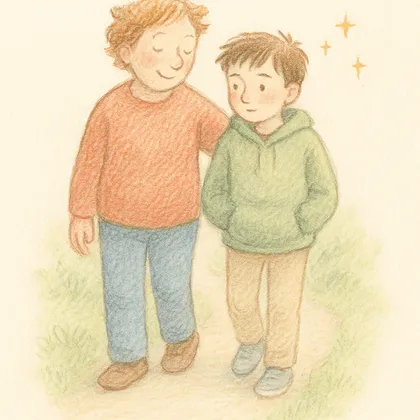
A couple of close, trusted friends do more good than a big crowd.
The short version.
Across childhood, friendship deepens from playing side by side into something built on trust, secrets, and mutual support. By adolescence, the hallmark of a good friendship is intimacy: being known and accepted by someone who has your back. Research consistently finds that having even one or two high-quality friends buffers stress and supports mental health, while a wide but shallow network does much less. A teen surrounded by acquaintances can still be lonely. The goal isn't popularity; it's having someone real.
What researchers actually find.
- Friendship in adolescence is defined by intimacy and self-disclosure, not just shared activity as in younger childhood.
- Even a single high-quality friendship buffers against stress, loneliness, and the effects of being disliked by the larger group.
- Quality of friendship predicts well-being better than the sheer number of friends.
- Online 'friend' and follower counts correlate weakly, if at all, with the closeness that actually protects teens.
You might recognize this.
- Your teen has a small circle and you worry they're not 'popular enough' — but they seem steady and content.
- They light up over a friend who truly gets them, not the biggest group chat.
- A lot of online connections can coexist with feeling no one really knows them.
How to help.
- Reassure yourself (and them) that one or two solid friends is plenty.
- Make your home easy to host in — close friendships grow with unstructured time together.
- Ask about the quality of a friendship, not the size of the friend group.
Ask your teen which friend they'd call at midnight if something went wrong. If there's a name, that's the win — say so.
A teen with few friends is failing socially.
One or two close, trusting friendships protect a teen more than a large but shallow crowd ever could.
Some teens are happily introverted with one friend; few friendships are only a concern when paired with real loneliness or distress.
This is a plain-words summary of well-established psychology — a map, not a diagnosis. If your teen is struggling in a way that worries you, a pediatrician or licensed mental-health professional is the right next step. In crisis: call or text 988 (Suicide & Crisis Lifeline, 24/7) · text HOME to 741741 · call 911 for immediate danger.