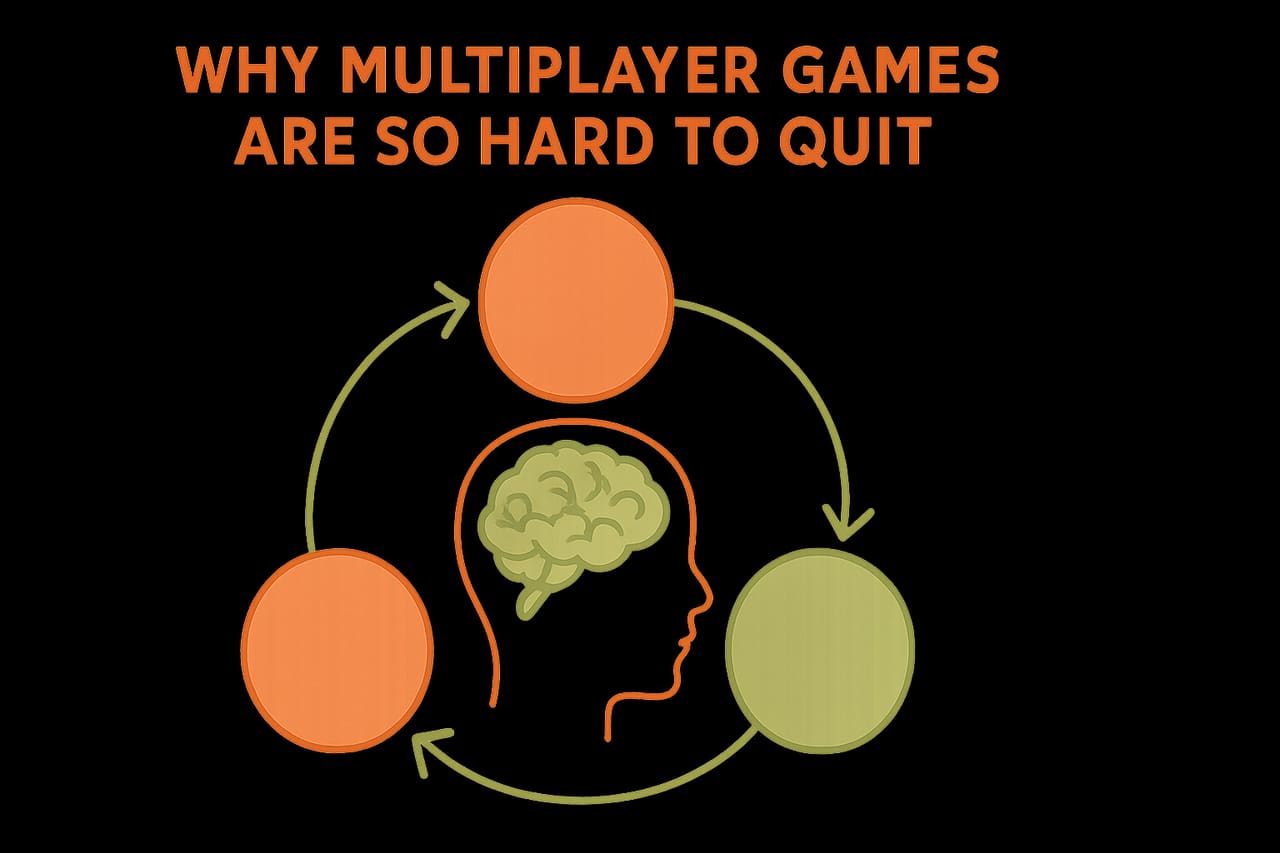
It's not weak willpower — it's three brain systems being pulled at the same time.
The short version.
Multiplayer games like Fortnite, Roblox, Valorant, League of Legends, and Minecraft are engineered to activate three psychological systems simultaneously: flow (the deep-focus state Mihaly Csikszentmihalyi described), social commitment (a real team that loses if you quit), and variable rewards (loot boxes, ranked progress, random drops). Each one is hard to interrupt. Together they make the 'just one more match' moment feel impossible to override — for adult brains too, and especially for teen brains where the reward system is hot and self-control is still catching up.
What researchers actually find.
- Flow states — described by Csikszentmihalyi from the 1970s on — require absorbing focus and clear feedback, both of which modern games deliver by design.
- Social-commitment costs in team games are real: ranked penalties, friend disappointment, in-group standing. The teen brain weights peer cost heavily.
- Variable-ratio reward schedules (loot drops, ranked LP, surprise events) produce the most resistant-to-extinction behavior in behavioral psychology — the same schedule that makes slot machines hard to stop.
- Teen reward responsiveness is amplified relative to adults; games hit teen brains harder than the same game hits the parent watching.
You might recognize this.
- “Five more minutes” that's actually 45.
- Mid-match rage when you ask them to stop — not because they're spoiled, but because you just triggered the social-commitment alarm during flow.
- Big mood swings around losses, ranked drops, or teammate decisions — they aren't 'overreacting,' they were inside a fully engaged brain state.
- Resistance to stopping that's much stronger in multiplayer games than in single-player ones, even ones the kid loves more.
How to help.
- Name the trap, not the character: 'These games are designed to be hard to put down, even for adults.' This lands much better than 'you have no self-control.'
- Use match-aware exits: 'finish this one' costs you almost nothing and respects the flow + team commitment. 'Off RIGHT NOW' breaks it and trains the rage response.
- Set the last-match time, not the stop time: 'last match starts before 9pm' is enforceable; 'off by 9pm' is a fight.
- For chronic struggle, change the environment — game stays in the living room, headset out of the bedroom at night, hard wifi cutoff via router. Willpower is the weakest tool against this stack.
This is a plain-words summary of well-established psychology — a map, not a diagnosis. If your teen is struggling in a way that worries you, a pediatrician or licensed mental-health professional is the right next step. In crisis: call or text 988 (Suicide & Crisis Lifeline, 24/7) · text HOME to 741741 · call 911 for immediate danger.