Of all the developmental windows in a human life, adolescence is the one that decides the most. Childhood lays the foundations. Adulthood builds on them. But the years in between are where the whole structure either holds, or doesn't. The body you are watching grow taller every month is also the body inside which a life is being shaped, in a way that nothing later will so fully redo. This is what makes these years so important. And it's also what makes them so easy to misread.
How early childhood actually reaches adulthood
You've probably heard that early childhood shapes adulthood. That's true. But it doesn't happen in some magical way. The route runs through adolescence. Whatever your kid carries from those early years, the good and the hard, passes through here on the way in. And here, it can get deepened, or, more rarely, rewritten. These years aren't a quiet stretch between two more important ones. They're the turning point.
Why we keep getting them wrong
Think back to when your child was a toddler. Remember how protective you were. Parents almost always underestimate small children, they can do more than we give them credit for. Then somewhere around twelve or thirteen, the flip happens. Our kid is suddenly as tall as us. Our daughter has a woman's body. Our son has a beard coming in. They look grown. So we treat them grown. We pull back. We expect them to handle things we wouldn't have asked of a much younger kid. The body fooled us. The mind is on a slower schedule.
What's slower? Most of what matters. They're still learning how to handle their emotions, especially the new ones that didn't exist in the toddler version of them. They're still learning how to handle new sexual feelings. They're being asked to step into social roles, friend, partner, almost-adult, future-something, that the world is starting to expect of them. But a year ago, they were a kid. The inside hasn't caught up to the outside. That's not something wrong with your kid. That's adolescence.
A peer world more complex than ours was
Now imagine doing all of that while standing in a hallway full of peers who are nothing like you. At twelve, some classmates already look like adults. Others are still little kids. The girl your daughter sits next to in math is fully developed. The boy at the next desk hasn't started puberty. Yours might be anywhere in between. They are all expected to relate to each other as if they're on the same page, when really, they're on completely different pages of completely different books. The social world your teen walks through every day is more complex than the one we walked through at their age.
The tightrope: love, or identity
The other thing happening underneath, quietly, is the hardest one. They are forming an identity. To do that, they need to begin separating from us, pulling back, going inward, asking the question who am I, really? not who am I in this house? And that means they have to find a version of themselves that lives beyond us, beside us, sometimes against us. Not because we did anything wrong. Because that is the work of these years. The problem is, they still need us for everything else. Financially. Emotionally. Psychologically. For the small instrumental things and the large ones. They are trying to leave a room they cannot yet leave.
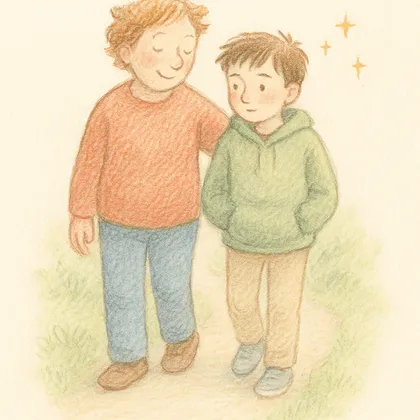
Which makes the parent walking alongside them a kind of tightrope walker. Lean too far toward closeness, hold them tighter, ask harder, keep them where they were, and you press down on the thing inside them that is trying to grow into itself. Lean too far the other way, give them all the freedom, tell them they're on their own now, treat them like the adult they look like, and you let go of the cord they still need. Both directions are loving. Both have a cost. If we are not careful, we sacrifice one of the two wings:
Our love, or their identity.
Closing
So this is what these years actually ask of us. Their world is complex. They cannot yet see themselves clearly. That is the work, and that is the job, to understand them, and to help them, slowly, learn to understand their own inner world. Not to control them. Not to fix them. Just to see them, more clearly than they can see themselves right now, and let that seeing be a kind of company while they figure out who they are. The body is ahead. The mind is catching up. We are here.
Source. Schulenberg, J. E., Sameroff, A. J., & Cicchetti, D. (2004). The transition to adulthood as a critical juncture in the course of psychopathology and mental health. Development and Psychopathology, 16, 799–806.
Download the same reading as a PDF, phone-friendly version or laptop version.
New readings land on Fridays for subscribers, monthly on Gold, weekly on Diamond, written for your teen's age, gender, and the specific thing you're navigating.
Membership writes you a custom Friday Reading, monthly on Gold, weekly on Diamond, matched to your teen's age, gender, and the specific thing you're navigating.
Your personalized Friday Reading lands in your inbox each week, and the full archive is open to you.