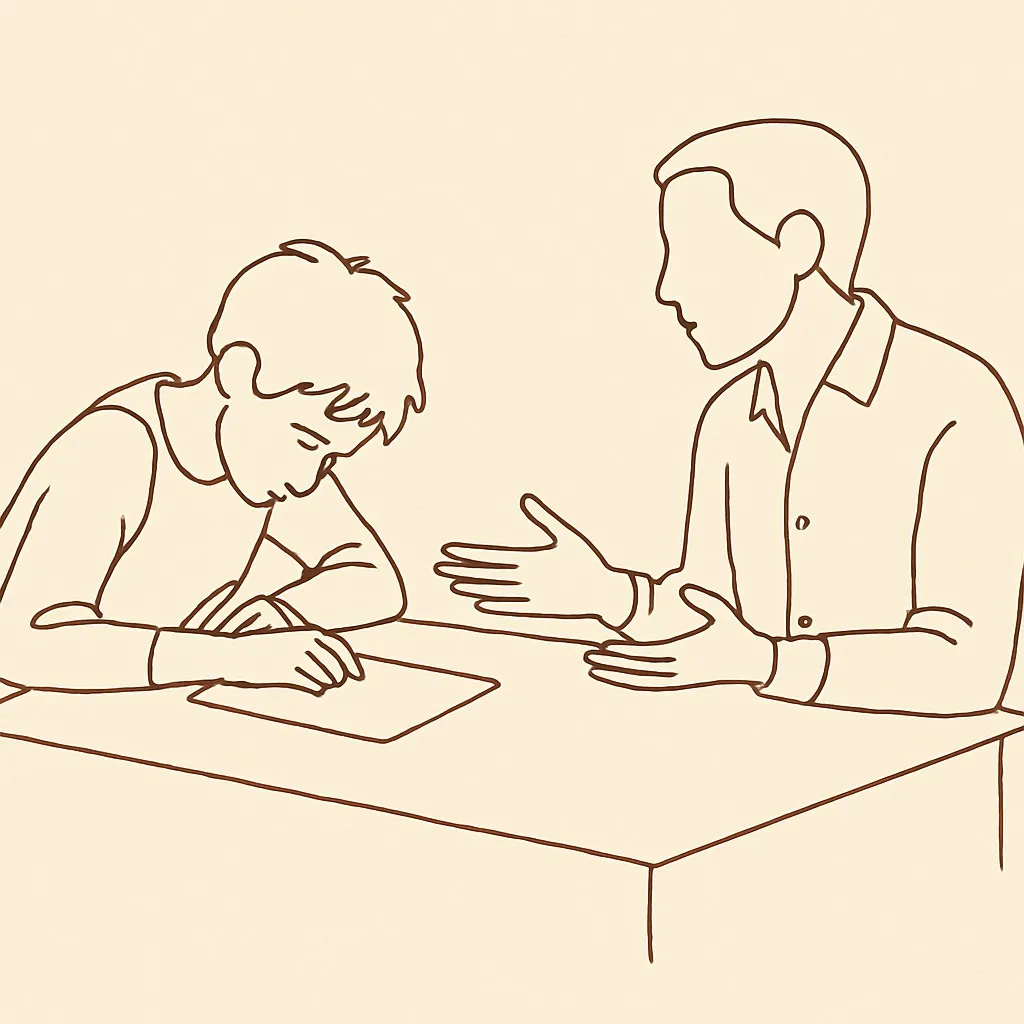
What's happening.
Your 14-year-old gets a B on a project they worked hard on. You say “good job” and move on. Two days later, in tears: “You never say you're proud of me. You just say good job and then bring up the next thing.”
What we usually say — and why it backfires.
Of COURSE I'm proud of you. I tell you all the time.
When?
All the time! Don't put words in my mouth.
I literally can't remember the last time. Whatever.
- “I tell you all the time” is the parent defending the feeling instead of giving it. The teen's complaint is that they don't hear it; arguing makes the case stronger.
- “When?” is a fair question and you don't have a real answer — defending an unfounded claim is the worst look.
- “Whatever” at the end is the teen logging another data point: when I express a need, I get defended-against, not given the thing.
What works — and why.
Wait. Come back. You're right — I assume you know I'm proud of you and I should say it out loud. I'm proud of you. I'm proud of the work you put into that project. I'm proud of how you treat your sister. I'm proud of who you're becoming.
...thanks.
Specifically about that project — I should have said: I saw how much research you did and how careful the citations were. That's the part that mattered, not the letter.
(small smile) Yeah. Okay.
- “Come back” is the magic word for a teen walking out hurt. Most parents let them go to “let them cool off”; the teen reads that as confirmation.
- Listing three specific things you're proud of (not just one) lands as truer than a single generic “I'm proud.” The brain accepts the multi-source signal.
- Coming back to the project specifically, with the SPECIFIC thing you valued, is the move that retroactively heals the original moment. Worth the 30 extra seconds.
Why this script works on a teen brain.
Parents underestimate how much explicit verbal pride matters to a teen and overestimate how much the teen infers it. Adolescent brain research is consistent: the teen reward circuit is hyper-sensitive to social-status signals from caregivers, but specifically the ones delivered in words. "Good job" doesn't land — it sounds like a closing line, not a feeling. Specific, named, multi-source pride lands like food to a hungry brain.
The parent who says "good job" then asks about the next assignment isn't being neglectful; they're following the script their own parents used. But it accidentally trains the teen on a transactional loop: achievement → brief acknowledgment → next thing. The teen's later complaint ("you never say you're proud of me") is them naming the loop and asking to be in a different one.
The one-shot fix: stop, come back, list three specific things, then loop back to the original moment with a more specific compliment than the one you gave the first time. 30 seconds of effort that rewrites the teen's memory of the original moment. Worth doing every time.
Same dynamic, different surface.
Your 16-year-old has been quietly leading a project at school for weeks — captain of a team that just won regionals. You weren't at the awards. When they walk in: "We won." You say "that's great, sweetheart!" Two hours later, in the kitchen: "You didn't even ask what I did."
What usually happens.
I said it was great! What more do you want?
I wanted you to be interested.
I AM interested. I asked you about it.
Forget it.
- "What more do you want?" frames the complaint as ingratitude. The teen wanted depth; they got defensiveness about the surface.
- "I AM interested" without proof is the same problem as "of course I'm proud" — assertion without evidence.
- Both of you are now arguing about whether you're a good parent instead of celebrating the win the teen wanted to share.
What works better.
You're right. I gave you a headline answer and you wanted the full one. Tell me about it — what was your part, what was hard, what worked?
...I was captain. I had to keep everyone on the same plan when we were down 8-3 at halftime. And I had to figure out how to talk to Maya, who was crying on the bench.
Both of those are leadership and they're hard. I'm proud of you for showing up for Maya — that's the thing I'm most proud of, honestly. The win is great. The Maya thing is who you are.
(quiet, then) Thanks.
- Asking three specific questions (your part / hard / worked) gets the actual story instead of the headline.
- Singling out the human moment (Maya) over the win signals you care about the person they're becoming, not just the trophy.
- "That's who you are" is the parent sentence that builds identity at this age. Worth saying when you mean it; never throw it around when you don't.
Key phrases to reach for in the moment.
- Wait. Come back.
- You're right — I assume you know and I should say it out loud.
- I'm proud of [specific thing]. I'm proud of [specific thing]. I'm proud of who you're becoming.
- (Pick one specific thing they did and name it back.)
When to use each one.
-
Wait. Come back.
Use the instant they walk away hurt. Three syllables that prevent two weeks of cold.
-
You're right — I assume you know and I should say it out loud.
Use as the open. Concedes without justifying; gets you to the real moment fast.
-
I'm proud of [three specific things, listed].
Use the list, not the singular. Multi-source pride registers as true; single pride registers as obligatory.
-
That's who you are.
Use ONLY when you mean it, and rarely. When real, it's the sentence they'll remember at 40.