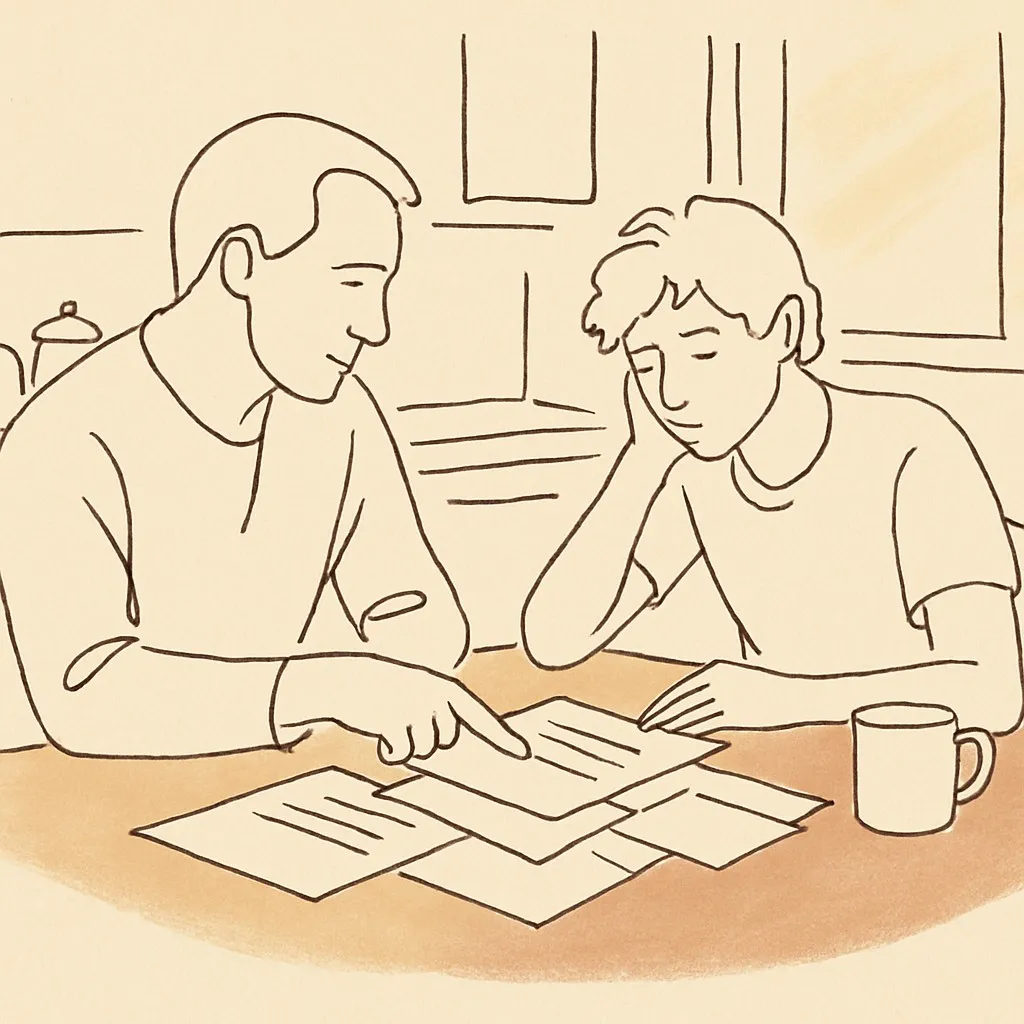
What's happening.
Your 13-year-old, after a peer-comparison moment: “Why are we poor? Everyone else's family has more money than us.” You set down the dishes.
What we usually say — and why it backfires.
We're not poor. We're middle class.
We never go on vacation, we don't have a new car —
Some people define poor as no food. We have food. Be grateful.
(internalizes that asking about money produces parental defensiveness; learns money is shameful to discuss)
- “We're middle class” is technically-correct categorization that doesn't address the comparison the teen made.
- “Some people define poor as no food” is the standard guilt-inducing global poverty deflection.
- “Be grateful” is the worst response to a financial question — produces resentment, not gratitude.
What works — and why.
Honest answer? We're not poor by US standards, but we're tighter than a lot of your friends' families, yes. Dad makes [actual amount range], I make [amount range], and rent in this area plus everyday stuff adds up. We have the basics covered and we choose to put money toward [thing the family does prioritize] instead of [thing other families do]. The 'why' is a mix of how much we make and what we prioritize. Anything specific you wanted to ask about?
Like, will we always be this way?
Maybe; we'd like to do better, and we work toward it. Money has a lot of luck and a lot of choices in it. Long answer is — your job isn't to worry about household money. My job and Dad's is to make it work. Your job is to figure out what kind of life you want, and we'll talk about how to get to it.
- Naming actual numbers (even in ranges) treats the teen as old enough for the truth.
- Distinguishing 'how much we make' from 'what we prioritize' gives them a real model of household finance.
- “Your job isn't to worry about household money. My job is to make it work.” names the boundary cleanly so the teen doesn't carry adult financial weight.
Key phrases to reach for in the moment.
- Honest answer? [Actual financial picture in age-appropriate detail.]
- The 'why' is a mix of how much we make and what we prioritize.
- Anything specific you wanted to ask about?
- Your job isn't to worry about household money. My job is to make it work.