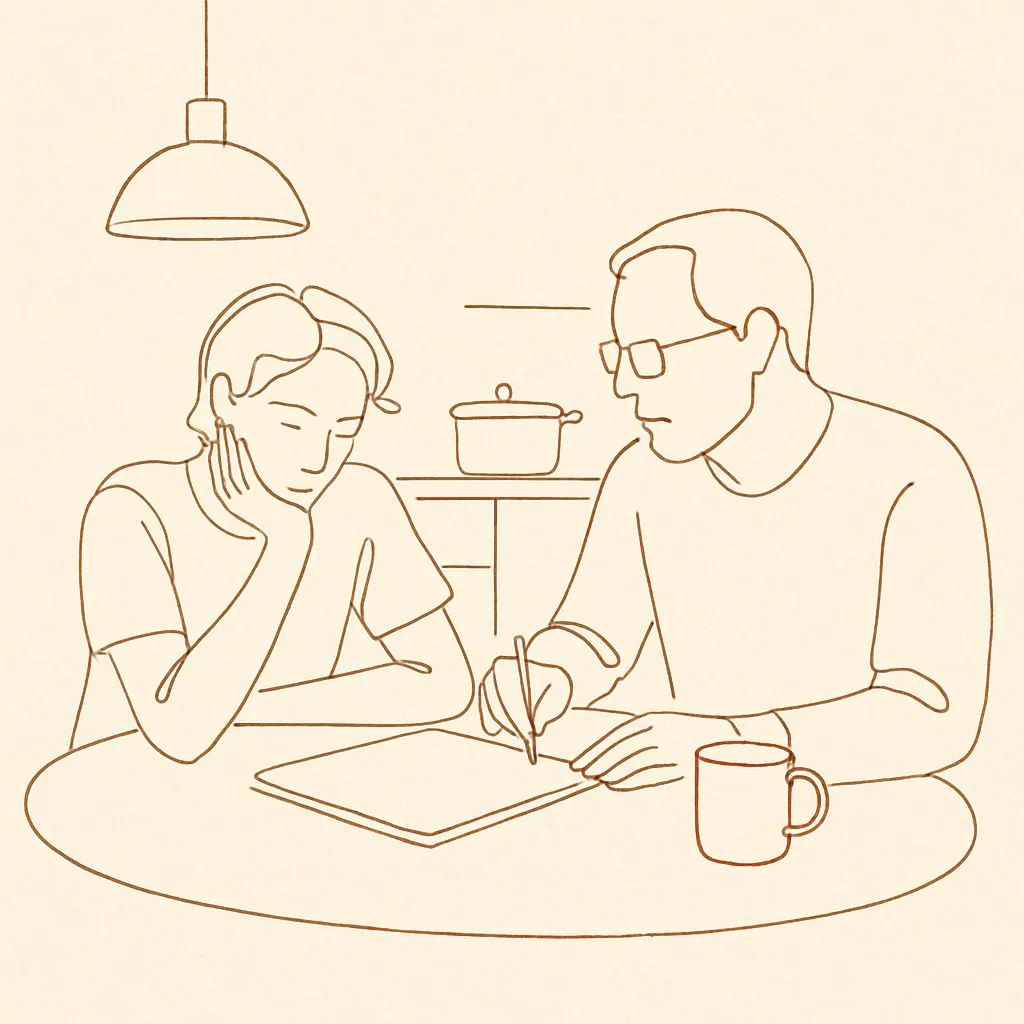
What's happening.
Your 17-year-old: “I want to get a tattoo. I've been thinking about it for a year.” You note the “for a year” — they've been preparing the ask. So have you.
What we usually say — and why it backfires.
Absolutely not. Not under my roof. You can get one when you're 18 and pay for it yourself.
I AM almost 18. That's two months.
Then two months. End of conversation.
Fine. I'll get it from someone's basement and you can deal.
- “Two months. End of conversation” treats the age threshold as the only relevant axis. They'll get it on their 18th birthday angrier, more rushed, and from a worse studio.
- Daring them with “you can deal” triggers the basement-tattoo response — which is now the public health problem you most wanted to avoid (infection, bad work, regret).
- You've used your veto and lost any influence on what the tattoo IS, which is the conversation worth having.
What works — and why.
Okay. Tell me about it — what design, what placement, why this one?
It's a small line drawing of grandma's hands. On my forearm. She taught me to draw and I want to carry that.
...okay. That's a real reason. Here's where I land — I'd rather you do this with us than around us. If we go to a reputable studio together when you turn 18, I'll go with you and pay half. The half is contingent on a reputable studio, not whoever your friend's cousin knows.
Deal. Thank you.
- Asking design / placement / why first surfaces whether this is a real considered decision or an impulse. In the real case, the answer earns your respect.
- “With us, not around us” is the parent move that converts adversary into ally. They will tell you the next big ask.
- Tying the cost share to studio quality (not to overriding the decision) keeps you influential where it matters — the safety part — without playing veto on the choice itself.
Why this script works on a teen brain.
The 17-year-old who tells you they want a tattoo is doing two things at once: making a decision about their body, and testing whether their parent can be a partner on a body-autonomy decision. The second part is the larger of the two. How you handle this conversation maps directly onto how they'll approach you in three years when the decision is about birth control, in five when it's about a wedding, in ten when it's about a baby.
The research on adolescent risk-taking and tattoo safety is clear on one thing: the studio matters far more than the timing. A teen who waits two months for their 18th birthday and then walks into a basement-cousin's-friend operation is at much higher infection and bad-work risk than a teen who walks into a reputable studio at 17 with a parent. The veto move ("no, two months") feels safe and produces the worse outcome.
The "with us, not around us" frame is one of the most-cited tools in late-adolescence parenting research. It generalizes: piercings, dye jobs, romantic relationships, first apartments. The parent who can say it and mean it gets the next ten years of disclosures. The parent who can't gets none of them.
Same dynamic, different surface.
Your 15-year-old, two years younger than the previous version: "I want a stick-and-poke. My friend Mira has done a few already, she's gotten really good." You taste copper.
What usually happens.
Absolutely not. Stick-and-poke is how teenagers get hepatitis.
Mira sterilizes everything. She uses real ink.
I don't care. Not a chance.
Cool. (does it next weekend without telling parent)
- Citing hepatitis is correct epidemiology and is now the parent yelling facts at a teen whose ears are closed.
- "I don't care" abandons the conversation just as the teen disclosed their actual plan. They will execute the plan without you next.
- The basement tattoo happens regardless. You've traded influence for veto and got neither.
What works better.
Okay. Tell me what you're picturing — what design, what placement, why now?
Something small on my ankle. A wave. Just because I like them.
Got it. My honest take: 15 is young, and stick-and-poke from a friend is the highest-risk version of this. Here's what I can offer — wait until 16, we research reputable apprentice studios that do small simple work for younger teens with parental consent in our state, and I'll go with you. That's a real path forward, not a stall.
...okay. That's actually what I wanted you to say.
- Engaging the design / placement / why first signals you're treating it as a real decision, not an impulse to swat.
- Naming WHY stick-and-poke specifically is the highest-risk version (vs. "any tattoo at any age") gives the teen a precise objection they can engage with.
- Offering a real path with a date attached converts a no into a roadmap. Teens follow roadmaps; they sabotage no's.
Key phrases to reach for in the moment.
- Tell me about it — what design, what placement, why this one?
- That's a real reason.
- I'd rather you do this with us than around us.
- Cost share is contingent on a reputable studio.
When to use each one.
-
Tell me about it — what design, what placement, why this one?
Use as the first response. Separates considered choices from impulses.
-
I'd rather you do this with us than around us.
Use as the core frame. Works for tattoos, piercings, dye, first apartments, first relationships.
-
My honest take: [specific concern about THIS version], not [the whole concept].
Use to surface your real worry. Specific concerns are negotiable; whole-concept refusal isn't.
-
That's a real path forward, not a stall.
Use when you're offering a delayed yes. The reassurance that it's not a stall is what makes them accept the delay.