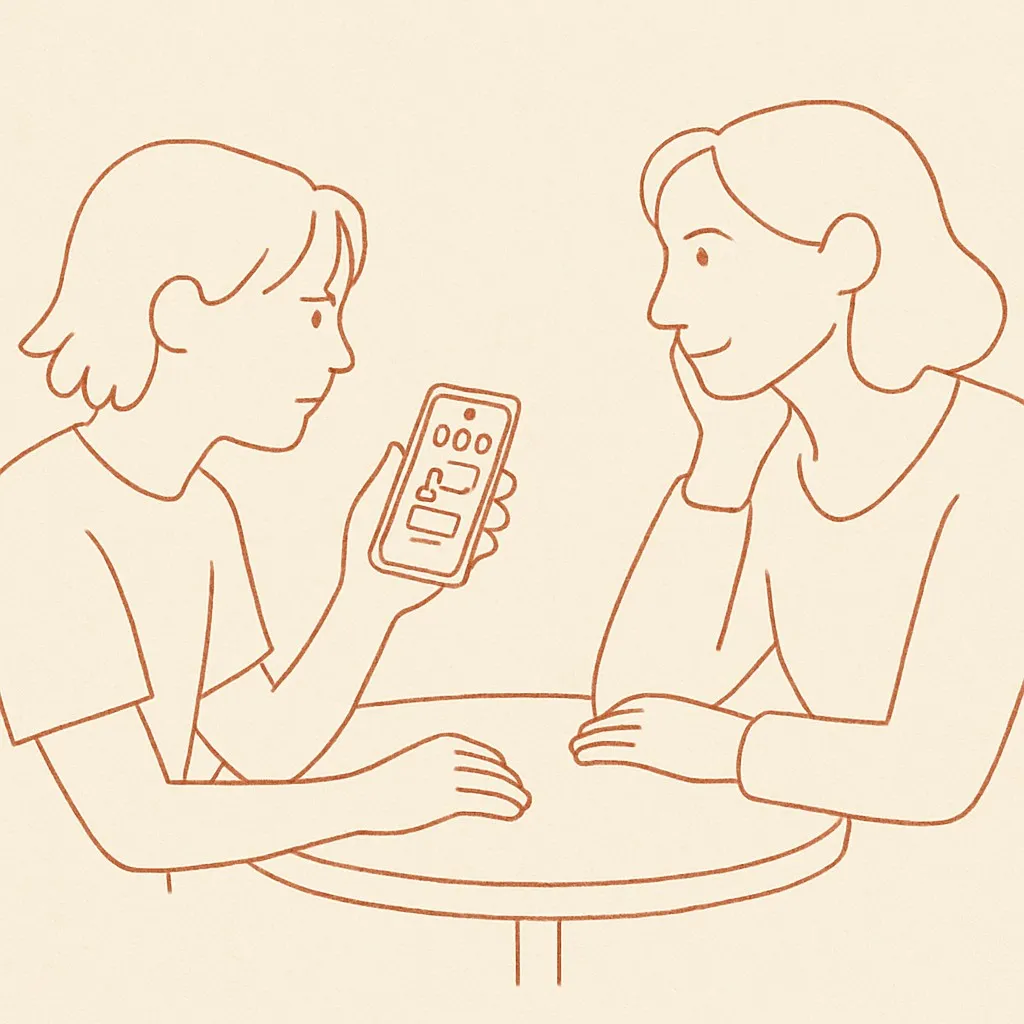
What's happening.
Your 13-year-old wants Snapchat, or to walk home alone, or to stay out past 9pm. The argument arrives prefabricated: “Everyone else's parents let them.” The instinct is to dismiss. The skill is to answer the real question underneath it.
What we usually say — and why it backfires.
Everyone else's parents let them have Snapchat.
I'm not everyone else's parents. The answer is no.
You always say that.
Then stop asking.
- “I'm not everyone else's parents” is technically correct and emotionally tone-deaf — your teen knows you're not their parents and that's not the point.
- “Stop asking” punishes the asking, not the underlying need (to belong, to feel normal).
- You miss the chance to find out what they actually want Snapchat for — which is the conversation that matters.
What works — and why.
Everyone else's parents let them have Snapchat.
I hear that. Tell me — what's it doing for them? What would it do for you?
Like… the group chat is on there. I'm the only one not in it.
Okay, that's actually a real problem, being out of the loop. Let me think. I'm still a no on Snapchat at 13 — and I'll tell you why specifically: streak pressure, disappearing-messages risks, predators DMing kids — but I want to solve the group-chat problem with you. What if we did iMessage or something else where I can see how it's going?
I guess.
- “Tell me what it's doing for them, what would it do for you” surfaces the real need (belonging) instead of fighting the surface ask (the app).
- Saying no but specifying why builds your credibility — the teen can argue with “no,” but they can't argue with “streak pressure, disappearing messages, predator DMs.”
- Pivoting to solve the underlying problem (the group chat) means the teen walks away with something, not nothing.
Why this script works on a teen brain.
"Everyone else's parents let them" is a teen surfacing two things at once. The surface ask (the app, the curfew, the trip) is often less important than the underlying ask, which is almost always about belonging. A 12-year-old without Snapchat in a sixth-grade class where the group chat lives on Snapchat is genuinely being excluded — and the parent who only argues with the surface misses the data the teen actually came to deliver.
The trap is to answer the surface or to dismiss the data. Both lose. "I'm not their parents" closes the door on the underlying ask without addressing it. "Fine, you can have Snapchat" answers the surface but doesn't engage with whether the surface is actually the right solution.
The move that works is to acknowledge the underlying problem as real, hold the surface no, and offer a third path. "You're out of the group chat" is a real problem; "Snapchat at 13" might not be the right solution. The third path (iMessage, supervised group, parent-side chat) keeps both the parent's no and the teen's belonging — and teaches the long-game skill of separating need from solution.
Same dynamic, different surface.

Your 12-year-old wants to bike to the park alone with two friends to meet some other kids. "Everyone else's parents let them. I'm the only one who has to have you drop us off." You notice you actually don't know if that's true.
What usually happens.
Well I'm not those parents. I'm dropping you off. End of story.
You're treating me like a baby. Marcus is biking and he's the same age.
I don't care about Marcus.
Forget it. I'm not going.
- "I don't care about Marcus" is technically correct and a relationship loss — the teen heard "I don't care that my independence is behind my peers'."
- Citing the rule without explaining your fear (traffic, distance, the specific intersection) leaves the teen unable to negotiate, so they refuse to participate.
- Both of you lose the social event that you'd wanted them to enjoy.
What works better.
Maybe other parents do let them. Tell me the route — which streets? Are you crossing 9th?
Yeah, but at the crosswalk with the light.
Okay. I'll be honest — 9th is the part I'm worried about, the rest is fine. What if I drove you to 11th, you biked the rest from there, no crossing 9th? You'd still be on your own at the park.
...okay. Yeah, that works.
- Engaging the route specifically ("are you crossing 9th?") signals you're considering it, not stonewalling.
- Naming the specific fear (the intersection) lets the teen problem-solve with you instead of against you.
- The compromise — drop-off short of the dangerous part — gives the teen 90% of the independence they came for, with the safety part addressed.
Key phrases to reach for in the moment.
- I hear that.
- What's it doing for them? What would it do for you?
- I'm a no on [the thing] and I'll tell you why specifically.
- I want to solve the [underlying problem] with you.
When to use each one.
-
I hear that.
Use as the first move on every peer-comparison claim. Acknowledges the data without conceding the ask.
-
What's it doing for them? What would it do for you?
Use to surface the underlying need. Almost always reveals belonging or status as the real ask.
-
I'm a no on [the thing] and I'll tell you why specifically.
Use when you have to hold the line. Specific reasons are arguable; vague rules become rebellions.
-
What if [partial yes that addresses the underlying need]?
Use to offer the third path. Almost always lands better than full yes or full no.