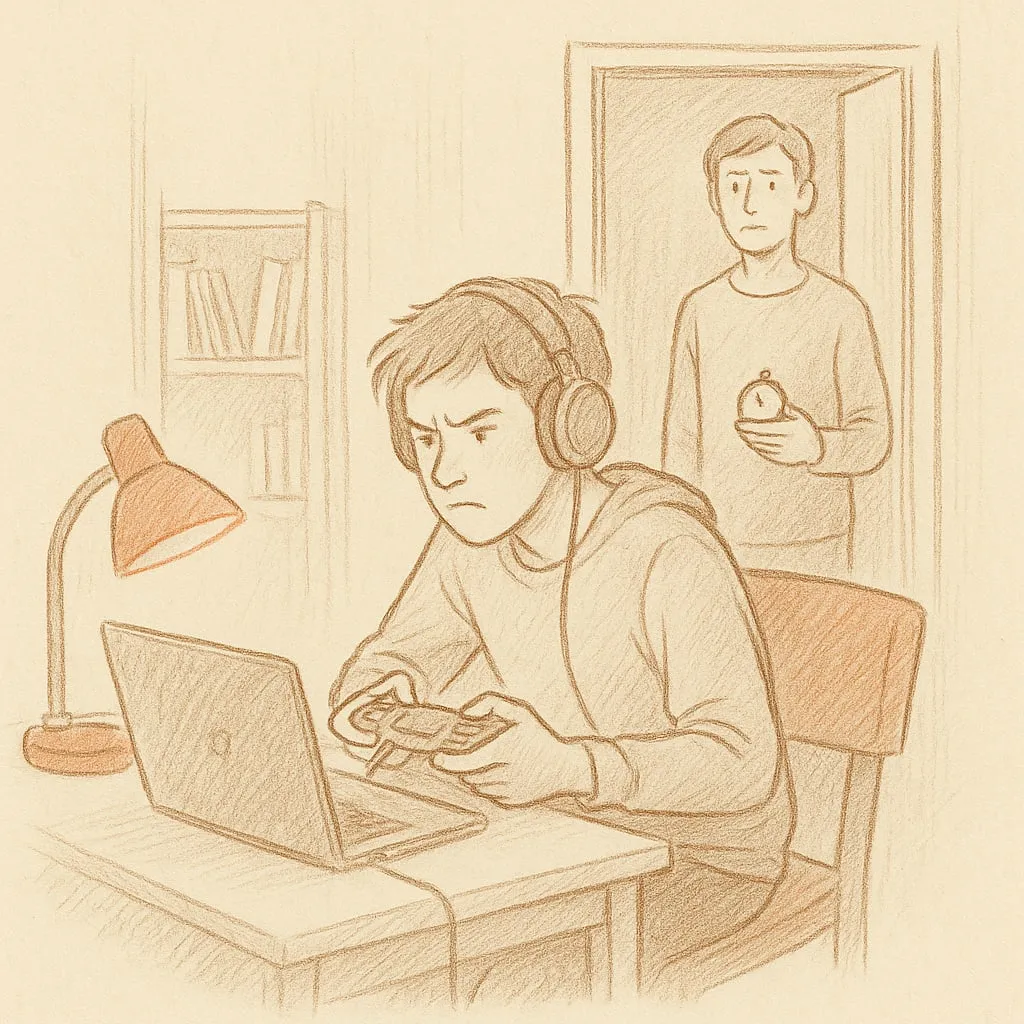
What's happening.
Your autistic teen has been deep in their game (or video, or special-interest wiki) for an hour. You say “okay, time's up, dinner.” They don't move — and when you reach for the device, the room detonates: shouting, tears, maybe a thrown controller. It looks like defiance. It usually isn't.
What we usually say — and why it backfires.
Time's up. I said now. Give me the tablet.
NO — you don't understand, I can't just stop!
It's just a game. Stop overreacting and hand it over.
(meltdown)
- An abrupt stop yanks them out of a state that's actively regulating them. For many autistic teens the screen isn't only entertainment — it's how they're managing sensory load and anxiety in that moment. Cutting it cold is closer to startling someone awake than ending a treat.
- “It's just a game” dismisses a special interest, which to an autistic kid can feel like dismissing them. It reliably escalates rather than calms.
- Grabbing the device removes their control at the exact second they have the least capacity to handle it — the meltdown is a nervous-system response, not a negotiation tactic.
What works — and why.
Heads up — ten minutes left, then we pause for dinner. I'll set the timer where you can see it.
I'm in the middle of something.
Got it. Is there a save point or end of the round in the next ten? Stop there, even if the timer beeps first.
...okay. End of this round.
Perfect. Round ends, we pause, it'll be right here after dinner.
- A visible countdown turns an ambush into a transition. Knowing exactly how much time is left does most of the work — the warning is the intervention.
- Anchoring the stop to a natural break (save point, end of round, end of episode) respects how the activity is actually structured. “Stop now” mid-task is far harder than “stop at the edge.”
- “It'll be right here after dinner” removes the hidden fear underneath a lot of screen meltdowns — that pausing means losing the thing entirely. Reassurance about resuming lowers the stakes of stopping.
Why this script works on a teen brain.
Transitioning off a preferred activity is one of the most documented difficulties for autistic young people, and screens raise the difficulty for two reasons at once. First, many games and videos are built to have no natural stopping point — the next round, the autoplay, the open-world map. Second, the screen is often doing a regulating job: it's predictable, visually absorbing, and lets a teen repeat a special interest in a world that otherwise feels loud and unpredictable. So “time's up” isn't ending a luxury; it's removing a coping tool with no warning.
The better script works because it adds the two things an abrupt stop strips out: predictability and control. A visible timer lets the brain prepare for the change instead of being startled by it. Tying the stop to a save point or end of round honors the structure of the activity so the teen isn't asked to abandon something mid-thought. And naming that the activity will resume — “we're pausing, not deleting” — defuses the catastrophic read that stopping equals losing it forever.
None of this is about lowering expectations. The expectation (we stop for dinner) stays exactly the same. What changes is the runway you give them to land the plane.
Key phrases to reach for in the moment.
- Ten minutes left — I'll put the timer where you can see it.
- Stop at the next save point / end of the round.
- We're pausing, not deleting. It'll be here after.
- What would make stopping easier?
When to use each one.
-
Ten minutes left — I'll put the timer where you can see it.
Open every screen-stop with this. The single highest-impact change you can make. A visible timer beats a verbal one because it doesn't rely on them tracking the clock in their head.
-
Stop at the next save point / end of the round.
Use instead of a hard clock time whenever the activity has natural seams. Ask which seam is closest rather than picking one yourself.
-
We're pausing, not deleting. It'll be here after.
Use the moment you see panic rather than anger — panic usually means they think stopping costs them the whole thing.
-
What would make stopping easier?
Use in a calm moment, NOT mid-meltdown. Autistic teens often have a precise answer (a longer warning, a specific end-point) that solves it for good.