
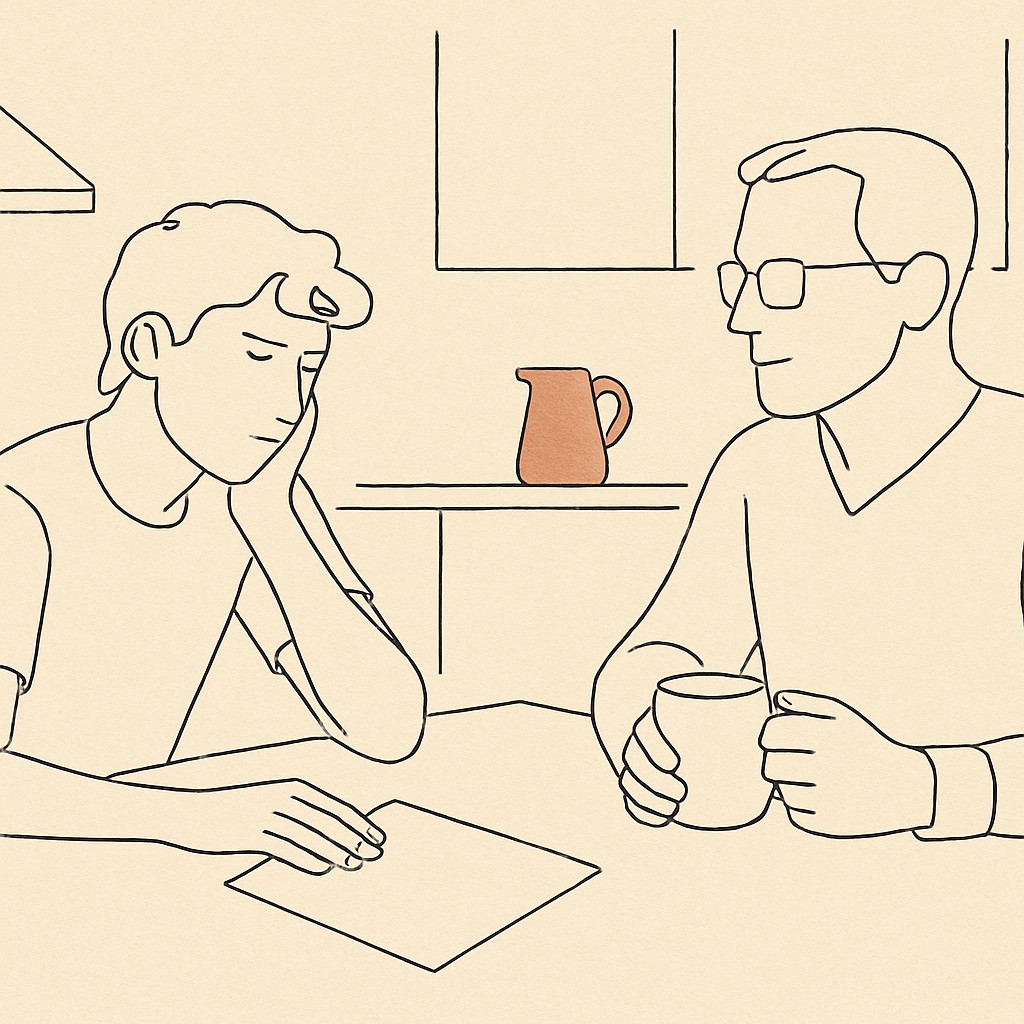
What's happening.
Your 15-year-old, paper face-down on the kitchen table: “I failed the chemistry test. 47.” You inhale.
What we usually say — and why it backfires.
FORTY-SEVEN? How did you even manage that?
I studied. It just wasn't enough.
You obviously didn't study enough. We need to talk about screen time.
(absorbs that bad grades = punishment cascade; hides the next one)
- “How did you even manage that” attacks the kid as if the grade were a character flaw.
- “We need to talk about screen time” takes a single test and connects it to a broader behavioral indictment.
- Long-term: students whose parents responded to bad grades with cascading punishments hide grades. That's the actual learning issue you create.
What works — and why.
Ouch. Okay. Tell me what happened — did you not get it, did you blank on test day, did you misread the study material?
I thought I had it. I studied for like five hours. I blanked on the stoichiometry part. The rest I got.
Got it. That tells me the studying wasn't wasted — you got most of it. Stoichiometry is the kind of thing where one missed concept tanks the whole section. Three options — talk to your teacher about a retake or makeup, get a tutor for just that unit, or work through Khan Academy with me this weekend. What sounds like the right fix?
Khan Academy. Then I'd want to ask about a retake.
- “Tell me what happened” treats it as diagnosable, not a verdict.
- Naming what they DID right (most of the test) before what they got wrong reframes from failure to specific gap.
- Concrete options (teacher, tutor, Khan Academy) give them agency and signal you're a partner in the recovery.
Key phrases to reach for in the moment.
- Ouch. Okay. Tell me what happened — did you not get it, blank on test day, misread the study material?
- That tells me the studying wasn't wasted — you got most of it.
- [Specific concept] is the kind of thing where one missed concept tanks the whole section.
- Three options — [teacher / tutor / together]. What sounds like the right fix?